

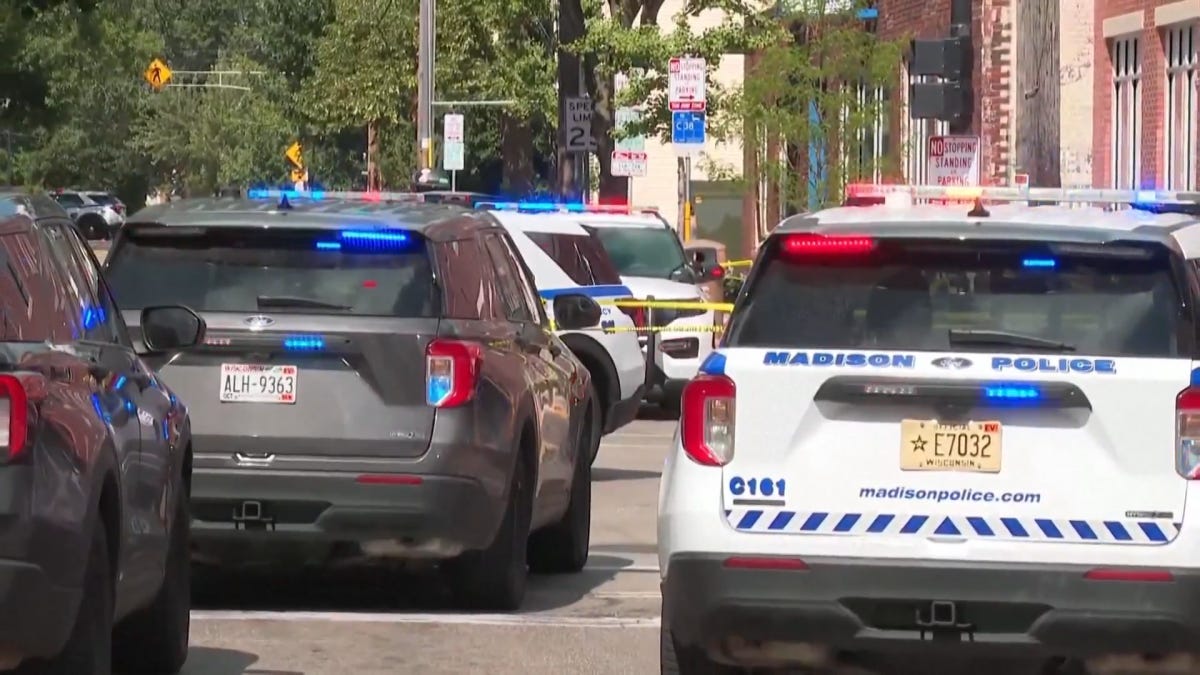
The police shooting of Corey Ruiz in Madison, Wisconsin has given rise once again to hundreds, perhaps thousands, of left-wing clairvoyant savants posting on social media about their visions of how every police interaction with a violent perpetrator, an offender resisting arrest, or a suspect who has a rap sheet as long as your leg, should go.
They look at an interaction that lasts less than a couple of minutes and can tell you exactly what the police should have done to avoid using deadly force even though most of them would soil their undies if they were faced with a situation where the continuation of their life was at risk.
Yep, these folks know exactly what would happen and because they have that crystal ball and the gift of foresight to see into the future, they know the police are simply bloodthirsty murderers who are trained to kill innocent people with only 35 arrests on their record, many, if not most, for violent acts yet have been streeted by some left-wing DA or judge.
They know that the suspect who thought it was a good idea to fight four police officers (who were armed with handguns, Tasers, and pepper spray) was completely unarmed because the police had taken one weapon from him already. They knew he didn’t have another knife or a pistol on his person – and more than that, as those seconds ticked away, they know the police knew the suspect was unarmed (even though they were still resisting with every ounce of strength they could muster) and always intended to murder the suspect, mostly because the suspect was black or brown.
Afterwards, after having hours of safety in front of their phones or computers to think about it, they know exactly what the police should have done to avoid murdering an upstanding citizen.
Just ask them. They will tell you. They know.
But that’s not the way it works in the real world.
In the real world, the person being detained gets a say in how things go.
In the moment, in the immediacy of direct contact with a person fighting to get away, police have seconds to decide what the threat level is to them or their fellow officers truly is and what to do about it. In that moment, a one second thrust of a knife or the squeeze of a trigger from a previously hidden firearm in the hands of a desperate individual fighting to escape, and a life is over.
Let’s break it down with numbers – and I’m going to use numbers from sources that are “liberal” in both the categorization of events as well as politically.
Here goes:
Out of a total population of roughly 350 million people, there are about 60 million police/public contacts per year in the United States (actual number of individual encounters is almost certainly higher, because many people have multiple contacts during the year). As a result of those interactions, roughly 1,000 to 1,400 people are killed by police, depending on which data source is used.
There is no single comprehensive federal database, so researchers often rely on independent organizations that track these incidents. The Washington Post‘s Fatal Force database, which records fatal police shootings, has found that police shoot and kill just over 1,000 people annually. Mapping Police Violence, which includes deaths from shootings as well as Tasers, restraints, vehicle strikes, and other causes, reports totals generally ranging from 1,300 to 1,400 deaths per year.
It should be noted that in raw numbers, white Americans make up the largest number of people killed by police each year, not black and brown people.
The overwhelming majority of those killed by police are reported to have been armed or perceived to present a deadly threat. Depending on the year and the dataset, roughly 90 to 95 percent of those fatally shot possessed a firearm, knife, vehicle, or another object capable of causing serious bodily harm. A much smaller number of cases involve unarmed individuals, replica weapons, or situations in which the person’s weapon status is unknown.
Most fatal encounters arise from responses to violent crimes, domestic disturbances, armed confrontations, or suspects actively resisting arrest in a manner officers believe poses an immediate danger. Cases involving unarmed, compliant individuals receive substantial public attention but represent a relatively small portion of fatal police encounters.
By comparison, police officers are themselves killed far less frequently. In a typical year, 50 to 70 officers are feloniously killed in the line of duty. Officer deaths are classified according to the circumstances of the encounter, such as arrest situations, traffic stops, pursuits, domestic disturbance calls, or investigative activities. Only a small number of officers each year are killed during incidents explicitly classified as arrest situations, although additional deaths occur during broader enforcement activities that may involve attempts to detain suspects.
The comparison between these two sets of statistics often enters public debate, but they should be interpreted carefully. The fact that approximately 1,300 suspects die at the hands of police each year while 50 to 70 officers are feloniously killed does not, by itself, establish whether police use force appropriately or inappropriately.
It does illustrate, however, that lethal force is relatively uncommon when measured against the enormous volume of police interactions each year and that the vast majority of arrests and police contacts end without anyone being seriously injured.
These are the same airheads who built the narrative about George Floyd, a drug using, drug dealing, convicted felon, that made him a martyr.
Now every suspect is George Floyd and every cop a potential murderer.
That narrative is proven false by the statistics and therefore dangerous.
It doesn’t mean that there aren’t bad cops or cops who make mistakes, but the actual numbers from sources (that have antagonistic relationships with police) prove it is false, even though it is repeated so often that it has become part of the mindset of people who now believe police are randomly murdering black and brown people because they are trained to kill (very similar to what these same people are doing to ICE agents).
Madison Mayor Satya Rhodes-Conway was quoted by CNN as saying, “It does not matter who you are or what your past is. You should not lose your life as a result of an encounter with law enforcement.”
That statement was not followed with, “…unless you roll the dice by presenting a credible, deadly risk by fighting with four police officers after stabbing one of them with your knife before you are disarmed.”
Thanks for the analysis and statistics. It could become very difficult to recruit and keep police officers in these larger liberal areas. Who would want to be in situations like this and not have the support of local officials. Mind numbing how lost the left has become in America.
Police are not beyond scrutiny. Bad cops exist. Mistakes happen. Deadly force must be investigated. But the anti-police narrative is statistically dishonest and morally dangerous. Tens of millions of police contacts occur each year, and the overwhelming majority end without serious injury. Most fatal encounters involve weapons, violent calls, resistance, or perceived deadly threats. The left wants every case judged backward from the death, not forward from the danger officers faced in real time. That is not justice. It is political theater. No one should lose life unnecessarily. But no one gets immunity from consequences by choosing violence during arrest.