
The Comey Rules
Fun to play by for a change, but will ultimately prove ineffective.

As much as I would like to see James Comey become some dude’s prison bitch, this “8647” thing isn’t going to cause it. While it may be fun to play by the Comey Rules for a while, ultimately it is going nowhere for a few reasons.
In all honesty, I remembered the LBJ threat case, but I looked the rest up and will ask the Members of the Redneck Legal Protection Society - the actual lawyers who keep me straight - to opine if I misstated or omitted something.
While some are going nuts about former FBI Director James Comey’s Instagram post depicting seashells arranged to form “8647,” interpreting that as a threat against President Donald Trump, this thing has no legs. Despite rightful outrage from Trump and his supporters (Trump avoided assassination at least twice and in my book, that gives him a lot of latitude) and ongoing investigations by the Secret Service and Department of Homeland Security, Comey is unlikely to face legal consequences due to the high legal threshold for prosecuting threats, the ambiguity of the post, and First Amendment protections, as established by key Supreme Court cases.
The primary legal framework for prosecuting threats against the President is 18 U.S.C. § 871, which criminalizes “knowingly and willfully” making threats. The Supreme Court’s decision in Watts v. United States (1969) set a critical precedent by distinguishing “true threats” from protected political hyperbole. In Watts, the Court overturned a conviction for a hyperbolic statement about targeting President Johnson, emphasizing that context, intent, and audience reaction matter. Comey’s post, captioned “Cool shell formation on my beach walk,” lacks explicit threatening language and is ambiguous, resembling the political hyperbole protected in Watts. Comey’s claim that he assumed the shells were a “political message” and his prompt deletion of the post further weaken any argument for willful intent.
The Elonis v. United States (2015) ruling adds another layer of protection, requiring proof of subjective intent to threaten. In Elonis, the Court reversed a conviction because the defendant’s violent social media posts were not shown to reflect deliberate intent. Comey’s denial of violent intent, coupled with his statement opposing violence, aligns with this standard. The “8647” formation, while provocative to some, is not a direct call to violence and can be interpreted as a vague political statement, especially given its use in anti-Trump protests as a symbolic “remove from office” message. Without clear evidence of intent to incite harm, prosecution under § 871 is unlikely to succeed.
Brandenburg v. Ohio (1969) further raises the bar for criminalizing speech, requiring that it incites imminent lawless action and is likely to produce it. Comey’s post, a static image without explicit directives, does not meet this threshold. The Foundation for Individual Rights and Expression (FIRE) has argued that the post is protected political speech, noting that “86” has multiple meanings and that interpreting it as a “true threat” via seashells is a stretch. The lack of immediate incitement or a specific target in the post makes it difficult to argue it poses a credible threat.
Context also matters. Virginia v. Black (2003) clarified that true threats require the speaker to communicate serious intent to harm. Comey’s history as a Trump critic may fuel perceptions of malice, but his post’s ambiguity and his swift retraction undermine claims of serious intent. The political climate, heightened by Trump’s survival of two assassination attempts, amplifies sensitivity, but legal standards remain stringent.
The practical reality of prosecuting a high-profile figure like Comey for an ambiguous post is daunting. The Secret Service’s investigation may result in a little chin music - questioning, inconvenience, or if he is capable of it, embarrassment, but without concrete evidence of intent or incitement, charges are improbable. Comey’s motivation is getting a little attention for another of his shitty books.
I’m not going to lie - it would be fun to see a little 6AM Roger Stone fully kitted up SWAT action at Comey’s place but neither Jimmy nor the usual assholes on lefty X (the Krassenstein brothers, Harry Sisson, others) are in real jeopardy.
The First Amendment’s robust protections, as reinforced by Watts, Elonis, Brandenburg, and Black, shield Comey’s “8647” post as political expression, however ill-advised. While the controversy fuels political division, and it may feel good to dream, in my distinctly non-legal opinion, it falls short of the legal threshold for consequences.
Comey is a dick, but unfortunately, being a dick isn’t a crime (and yours truly is personally happy the dick standard is high enough for him to get under).
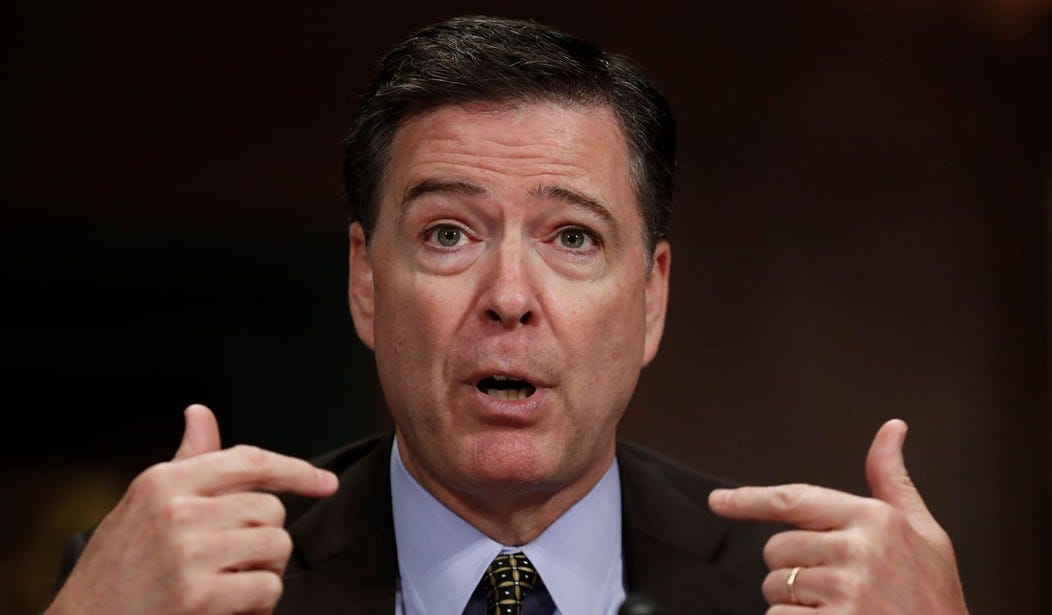
The caption for that photo should be “Moi?”
Clear as day to most people what the message was. First Amendment protected harmful actions toward Jewish students, with no legal consequences, so the First Amendment has lost credibility.
I agree with you, and for the same basic reasons. Brandenburg is a very high bar, as are other laws and cases. It doesn't help that there is merchandise with "86" for both "46" and "47," either. I think the major part of this is that we all know Comey knows better and that it's obvious he's lying. In this case, I at least hope he's nervous. Maybe it's time that the "process" becomes the punishment in the opposite direction.