
Secession Without Declaration: The Dissolution We’re Not Allowed to Notice
When states reject both federal law and shared values, the union exists only on paper. America is devolving from civic nation to legal fiction, and no one wants to admit it.

We often use the terms “nation”, “country” and “state” interchangeably when they mean very distinct and different things.
A nation is more than lines on a map and more than the legal machinery of government. It is a shared identity forged through common beliefs, values, and social norms that evolve over generations. The United States has long exemplified this concept of a civic nation—a country bound not by ethnicity or ancient heritage, but by a broad consensus on constitutional principles, democratic values, and behavioral standards that emerged over 250 years of shared history.
History teaches us that such unity is fragile and once broken, nearly impossible to restore. A civic nation can devolve into merely a state, a hollow legal shell stripped of the cultural cohesion that once gave it meaning. More troubling still, through either manufactured or genuine “resistance”, political subdivisions within that state can drift so far from both the federal legal framework and the civic foundations that they exist in a condition of de facto secession—never formally declared but unmistakably immediate and real.
The distinction between nation and state is crucial to understanding this phenomenon. A state possesses sovereignty, defined borders, governmental authority, and the power to enforce laws. A nation, by contrast, is a community united by culture, history, language, and shared values. When these two concepts align, we have a nation-state. America, despite its diversity, achieved this alignment through the development of common beliefs about individual rights, democratic governance, and the rule of law. These weren’t imposed from above but evolved organically through collective experience, debate, and the painful work of building a shared identity.
But what happens when that shared identity fractures beyond repair? For example, when different regions (or established political subdivision—like an American state) no longer agree on fundamental values or accept the legitimacy of common institutions?
The civic nation dies, leaving behind only the state apparatus. The Constitution still exists, Congress still meets, federal agencies still operate—but the social contract is void. What remains is governmental machinery operating through inertia and coercion rather than consent. The country only persists as a legal fiction while ceasing to function as a unified nation.
It seems that reality is already here. When political subdivisions systematically refuse to abide by, or support the enforcement of, federal law, they aren’t engaging in principled federalism—they’re rejecting the constitutional order itself. When they simultaneously repudiate the broader civic norms that have defined American identity, they complete the separation. This is de facto secession, and pretending otherwise is dangerous naivety. A state that remains technically part of the union while operating in fundamental opposition to both its legal structure and its cultural consensus has already left.
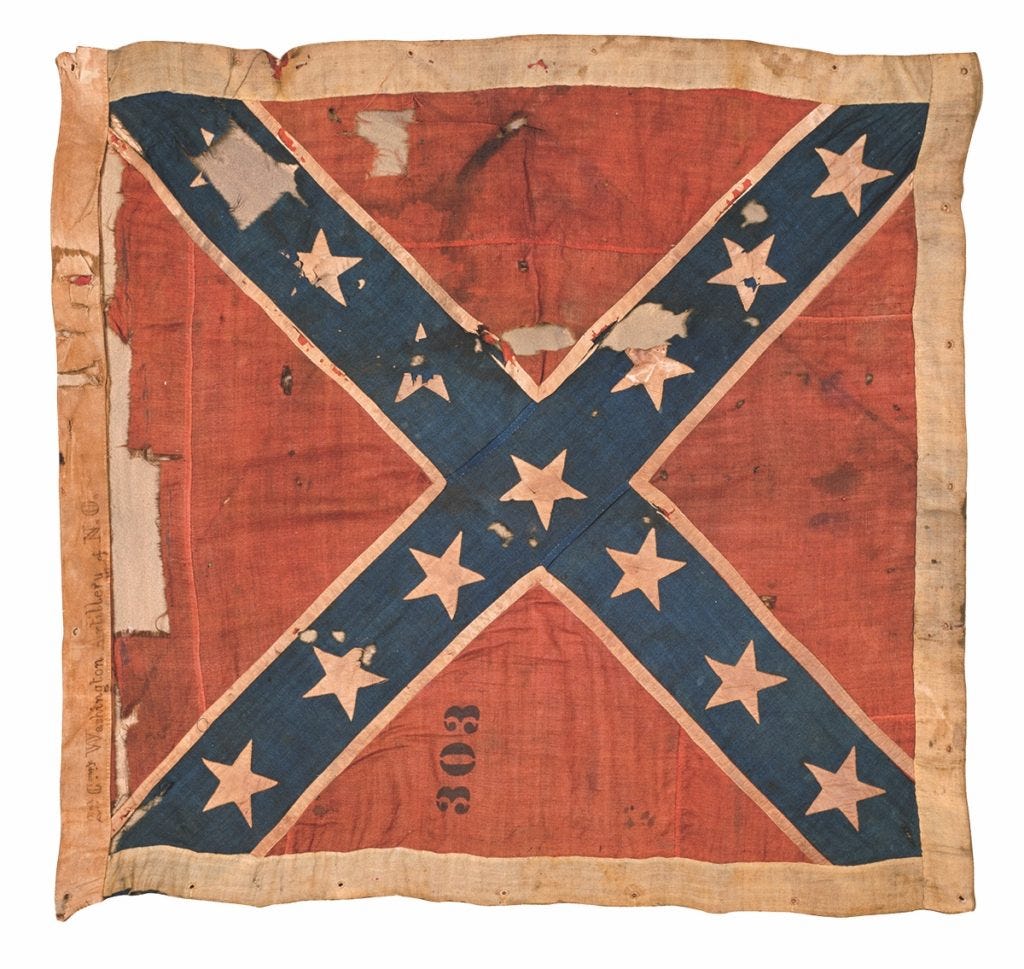
In the 1850s, Southern states increasingly rejected not only federal authority over slavery but also the evolving national consensus that slavery was morally incompatible with American principles. They denied the legitimacy of laws they disliked and dismissed the values of their fellow Americans as tyrannical impositions. Long before Fort Sumter, the South had effectively seceded in spirit and practice. The formal declarations of 1861 merely acknowledged a separation that had already occurred in every meaningful sense.
De facto secession doesn’t require constitutional conventions or dramatic pronouncements. It manifests in the systematic defiance of federal law, the rejection of judicial authority, and the explicit repudiation of shared national values. It appears when state officials declare that their interpretation of rights and governance supersedes federal authority, when they actively obstruct the implementation of national policy, and when they cultivate a regional identity defined in opposition to the broader American project. The formal legal structure persists, but the practical reality is separatism. Call it what it is.
This scenario presents a profound danger precisely because it operates in a gray zone that our system was never designed to address. Traditional federal enforcement mechanisms assume good faith participation in the constitutional system and are designed to address isolated disputes, not wholesale rejection of federal authority. When a state positions itself as fundamentally opposed to both the legal order and the civic values of the nation, the tools for resolution evaporate. Negotiation requires common ground that no longer exists. Legal enforcement becomes politically explosive and potentially impossible.
The alternative—accepting permanent internal division—means acknowledging that the nation-state has already failed, that we are simply waiting for someone to say it out loud.
The devolution from civic nation to mere state, and the drift of subdivisions into de facto secession, represents the collapse of the American experiment’s core premise: that diverse people can unite around shared principles and build a common identity through democratic self-governance. When regions conclude that they share neither values nor legal obligations with their fellow citizens, the center cannot hold. The skeleton of statehood without the living tissue of nationhood is a condition that history demonstrates is simply not sustainable.
The question is not whether this dissolution is happening, I would submit the example of Minnesota proves it already is, and other blue states are next in the lunch line. Pretending otherwise does not seem wise. The question is whether Americans have the courage to acknowledge it and the will to decide what comes next.
Is there any process to revoke a state's statehood? To rescind their admittance?
Mini-states abound as well. Consider Montgomery County, Maryland. I get local news blurbs. Today it contained: The Montgomery County Council will meet Tuesday, Jan. 13, beginning with proclamations recognizing Muslim American Heritage Month and Korean American Day. BTW, the council is 100% Democrat.