
Perverse Incentives
DOGE highlights waste, fraud, and abuse but it also exposes the psychology of government and how the people trusted to manage it are incentivized.

Jesse Waters’ interview with Elon and his DOGE team seemed to be about finding and ending waste, fraud and abuse that we all intuitively know exists in government – but only if one takes it at face value. Beyond the obvious costs to the American taxpayer (and everybody else through higher interest rates and inflation caused by government policies), and when you apply deeper level thinking, you come to see the perverse incentives that drive all of it.
Various Congressmen have been producing annual “pork” reports for decades, but like the weather, everybody talks about it, but nobody ever does anything about it.
In the cutthroat, competitive world of business, survival hinges on aligning actions with self-interest. A company that squanders resources or deviates from its core mission risks bankruptcy, as market competition ruthlessly punishes inefficiency. Yet, as Elon Musk’s Department of Government Efficiency (DOGE) initiative has underscored, the United States federal government operates under a different set of rules. Far from being penalized, failure and inefficiency in government are often rewarded with increased funding, bloated payrolls, and a dilution of stated missions. Historian Robert Conquest’s three laws of politics - particularly the notion that organizations, given time, become enemies of their own missions - provide a lens to understanding this phenomenon.
In government, failure is not just an option; it is an outcome.
Conquest’s laws, though rooted in political science, resonate deeply with the critique Musk’s DOGE has brought to the forefront. Conquest’s third law suggests that any bureaucratic organization, left unchecked, evolves into a self-serving entity, prioritizing its own perpetuation over its original purpose. The federal government exemplifies this. Agencies tasked with clear objectives - say, ensuring public safety or advancing scientific research - often morph into sprawling bureaucracies where inefficiency is not a flaw but a feature. When programs underperform, the response is rarely to streamline or eliminate them. Instead, failure becomes a justification for more: larger budgets, additional staff, and expanded mandates. This perverse incentive structure ensures that government grows not despite failure, but because of it.
DOGE has spotlighted this dysfunction. Posts on X and other social media have cited ambitious goals, such as $2 trillion in budget cuts and a 33% reduction in the federal workforce. Proponents argue that such measures could force agencies to focus on core missions, eliminating waste and redundancy. DOGE’s real contribution lies in exposing a truth Conquest long ago articulated: government agencies, insulated from market-like accountability, drift toward self-preservation at the expense of effectiveness.
Consider the Department of Education, created to improve educational outcomes. Decades later, despite ballooning budgets, student performance metrics like literacy and math proficiency have stagnated. Rather than reevaluate its approach, the department often secures more funding to address the very problems its expansion has failed to solve. This cycle - failure begets growth - dilutes the mission and entrenches inefficiency. Unlike a business, which would face insolvency for such missteps, government agencies face no existential threat. Taxpayer funding and political inertia shield them from the consequences that discipline private enterprises.
Conquest’s laws suggest this is inevitable without deliberate intervention. His first law - that everyone is conservative about what they know best - explains why bureaucrats resist reform; they cling to familiar, if broken, systems. The second - that organizations simplify complex realities to justify their existence - fuels mission creep, as agencies expand to appear indispensable. Together, these dynamics create a government that, as Musk’s DOGE critiques, thrives on inefficiency.
Reversing this requires rethinking incentives. It is claimed that government cannot operate like a business because it lacks a profit motive - but in business, manufacturing operations are often considered “cost centers” where no profit motive exists. Their goal is to meet or beat quality, delivery, and the standard costs calculated for products. Success or failure is measured in positive or negative variances from that standard. Government may not be able to mimic business entirely but it can adopt a “cost center” approach with clearer success metrics, rigorous oversight, and consequences for failure.
DOGE’s bold proposals may not be perfect – but in business, the perfect should never be the enemy of the good. Those proposals force a reckoning with Conquest’s warnings. If the government is to avoid becoming its own enemy, it must confront the reality that failure should never be an outcome worth rewarding.
The result of this decades old metastasizing is that the American taxpayer has been, and still are, paying the bill for every bad idea from John Kennedy forward – plus interest.
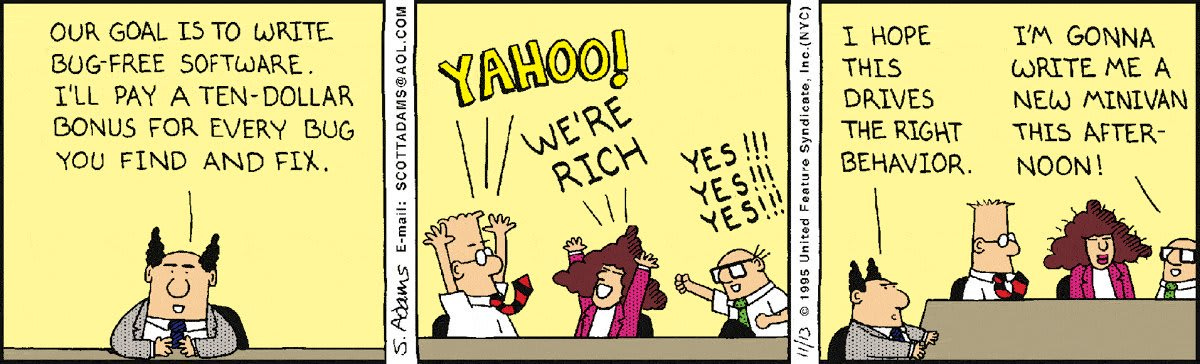
Indeed, for government bureaucrats, bugs are the desired outcome. Each one "found" drives an increase in the budget for bug spray.
Good analysis.