
Moral Sentiments
Democrats aren't wrong about everything, just the important stuff.

A couple of things I have heard from Democrats this past week:
If a black person is a Democrat and the reaction to that person is limited to their politics, it is really just racism.
If a person gets rich through participating in free enterprise and some unscrupulous people do too, it means that all free enterprise is evil.
Both statements rely on faulty reasoning that substitutes assumption and generalization for evidence. The first assumes that criticism of a black Democrat must secretly be motivated by racism, even when the criticism is explicitly political — a kind of unfalsifiable “Kafka trap” logic where denial itself is treated as proof. The second commits a hasty generalization fallacy by arguing that because some unscrupulous people become wealthy through free enterprise, the entire system is inherently evil. In both cases, the argument projects the motives or character of individuals onto a broader category without ever proving the connection.
Several years ago, I wrote about how racism was employed as a national political tactic for the first time in the 1964 presidential election. Barry Goldwater, the Republican candidate, was a conservative, and since racist Democrats had also promoted conservative values, Goldwater had to be a racist. In an incredible twist of hypocrisy and irony, while Goldwater was campaigning, Democrats were fighting against the Civil Rights Act, and newly elected Alabama governor George Wallace was delivering his infamous “Segregation Forever” speech.
Wallace’s speech contains many recognizable conservative points — individual liberty, states’ rights, free markets, limited government, faith in God — but none of those principles are racist in nature. They do not require belief in white supremacy, discrimination against minorities, or race-based laws. They are the principles this nation was founded upon, and they are entirely race-neutral. Racism has nothing to do with conservative ideals; the two are fully severable. Just because someone is a conservative does not make them a racist, which also means people of all races can be conservative — unlike Joe Biden’s assertion that if you don’t vote Democrat, “you ain’t black.”
Contemporary Democrats, like their communist progenitors, are at war with capitalism and the success it produces. At its most basic, capitalism is the free-market philosophy that uses price as a signal for the market to adjust and respond. It rests on a simple concept: a transaction occurs at the point where a seller is willing to sell and a buyer is willing to buy. This one-on-one, individual philosophy allows the price of any good or service to be set by the people involved, based on the value each places on it. In my mind, there is no more equitable, fair, or moral method of economic exchange than this.
Capitalism, like any economic system, is merely a reflection of the individuals within a society. In a free society, the quality of that society and of its economy depends on the quality of its people. Ayn Rand and Milton Friedman both built their positions on the proposition that individuals acting in their own rational self-interest will yield the best outcome for society as a whole. Capitalism isn’t a cause; it is an effect, the result of being free to choose.
This is really sort of a test if a society is truly a free society, isn’t it? Since freedom means that individual people can choose to do good or bad things, one might deduce that a society with no “bad” people isn’t truly free. A free society also has fair and just mechanisms to deal with those who choose to exercise their freedom badly.
Adam Smith addressed this directly in what I consider his most important work, The Theory of Moral Sentiments, written before The Wealth of Nations. Smith argued that human beings are not driven solely by self-interest, but by a deep moral instinct rooted in what he called “sympathy”, something closer to what we now call empathy. He believed people naturally seek the approval of others and develop moral behavior by imagining how an “impartial spectator” would judge their actions. Virtue, for Smith, emerged from balancing self-interest with prudence, justice, and benevolence. He warned that wealth and ambition corrupt judgment when detached from virtue, and he held that justice is the indispensable foundation of civilization. Far from celebrating greed, Smith contended that healthy commercial societies require individuals with enough moral formation to temper self-interest with conscience and social obligation.
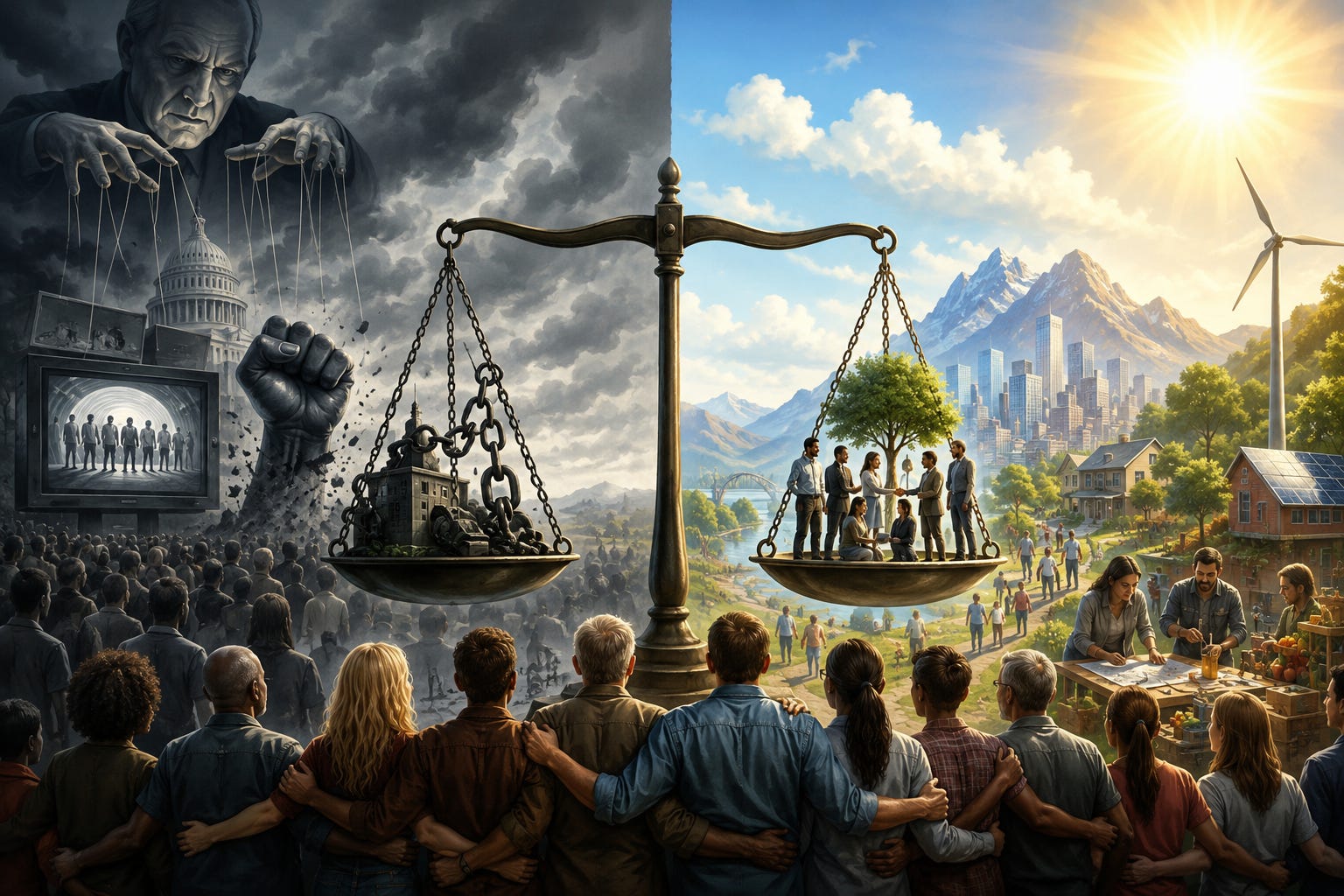
What Rand, Friedman, and Smith are collectively saying is that if individuals act morally, society will reflect those qualities. What Bernie Sanders and Alexandria Ocasio-Cortez are saying is that freedom is the problem, and if we simply surrender it to their guidance, corruption will end. Too bad history tells a different story. Human failings are not eliminated in collectivist systems; they are actually concentrated and institutionalized.
I won’t make the same mistake they do and claim Democrats are wrong about everything, but they are wrong about a great deal—including conservativism always equaling racism and capitalism always being evil.
"If a black person is a Democrat and the reaction to that person is limited to their politics, it is really just racism."
And conversely, if a black person is a Republican and the reaction to that person is limited to their race, that's not racist because they're a "sellout".
Electing a white person when there was a viable black candidate is only racist if the white person is a republican and the black person is a democrat.
Examples abound.
Some people are wrong because they don’t have all of the facts. Some people are wrong because they have a need to feel morally superior to others, so they diminish them.