
A Framework, Not Folkways
Why the absence of a single American ethnic identity is not a weakness, but the secret to Western civilization’s durability and universal appeal.

I think I understand why people insist that America doesn’t have a distinct culture.
I’ve been thinking about this since I finished historian David Hackett Fischer’s Albion’s Seed: Four British Folkways in America last year and came away with an understanding of just how different the colonial influences truly were.
People who claim there is no American culture look around and see no single ethnicity, no single cuisine, no single language origin, no single ancestral myth tying the whole thing together. They see adaptation, borrowing, reinvention. They see hamburgers next to sushi, St. Patrick’s Day parades in cities with no Irish majority, and hip-hop performed in rural towns. To some, that fluidity looks like cultural emptiness.
But what if that flexibility is the culture?
The American expression of Western civilization is not culturally dependent in the way older nations are. While France is inseparable from “Frenchness” and Japan is inseparable from Japanese tradition, America, though born of Western civilization, is not bound to one tribe, one ethnicity, or one historical grievance. It developed its own customs, habits, and symbols, yes, but its core is not folkways. Its core is a framework.
What we call American culture is better understood as a set of values, beliefs, and processes refined over centuries to answer the most basic and persistent human questions: How do we secure food? How do we protect ourselves from the elements? How do we create safety and stability so life—and liberty—can flourish?
Property rights, rule of law, contract enforcement, a stable judicial system, free exchange, limited government, individual liberty— these are not ethnic traits. They are civilizational tools. They are the accumulated results of thousands of years of trial and error—failures of monarchy, theocracies, tribal war, collectivist experiments, mercantilist distortions—distilled into systems that work better than the alternatives at producing prosperity and order.
Since this system is not rooted in blood or soil, it is portable.
That portability is what critics often mistake for cultural absence. America can adopt and adapt because it is not anchored to one ancestral story. The left calls this “cultural appropriation,” as if borrowing were theft. The right calls it “assimilation”. In reality, it is neither and both, an integration into a value and principle framework that functions regardless of who practices it.
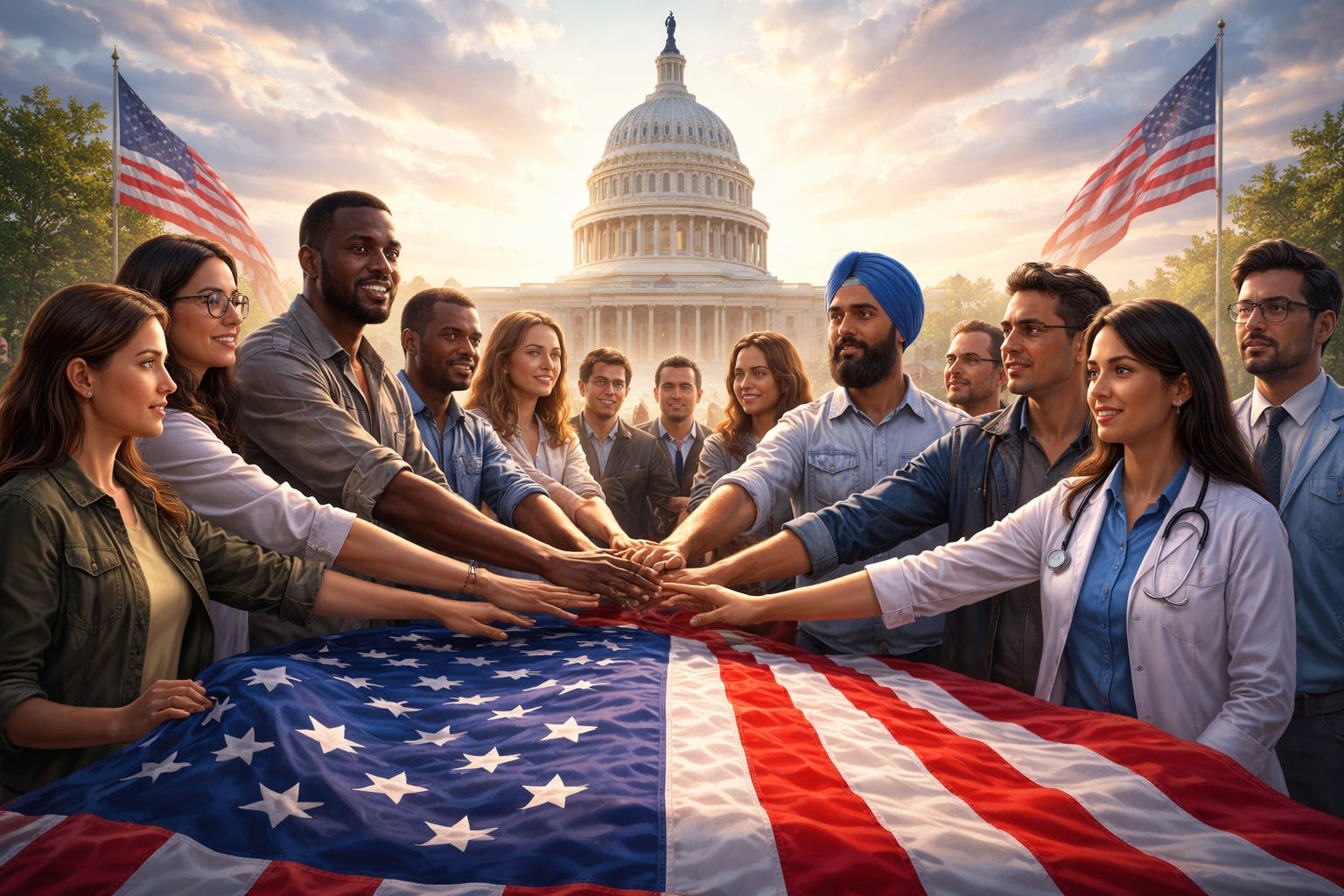
You do not have to be Anglo-Saxon to believe in private property. You do not have to trace your lineage to the Mayflower to value free speech. You do not have to descend from European peasants to benefit from constitutional limits on power. Any race, religion, or ethnicity can practice these principles and enjoy the advantages produced by centuries of institutional refinement.
That is not cultural emptiness. I think it is something more, a kind of civilizational universality.
Western civilization, and particularly its American branch is not designed to tell you who you are. It does not assign identity, nor does it prescribe your purpose. The system’s genius is not that it defines meaning, but that it protects the space in which individuals can pursue it. By steadily improving the mechanisms that make food, clothing, shelter, and security more accessible, it lowers the cost of survival. As survival becomes easier, more people gain the freedom to ask deeper questions about art, philosophy, faith, and purpose. The civilization does not hand you transcendence; it creates the conditions in which you may seek it.
That is why America can appear culturally thin while being structurally deep. That “civilizational universality” is also the true magic of our constitution and the government it defines (no matter how much it has been bastardized into what it is today).
When critics say America has “no culture,” what they often mean is that America does not enforce a single narrative of identity. It does not require conformity to ancient custom and does not demand ethnic continuity. It asks only that you operate within a framework of law, liberty, and responsibility.
Because it is not culturally dependent, anyone can practice it, and because anyone can practice it, it can absorb the world without losing itself—so long as the underlying values remain intact. The real danger to American civilization is not cultural diversity. It is the erosion of the principles that make diversity workable in the first place.
America is not a tribe— it is a process, and processes, when they work, do not need a single face to endure. By trying to remake the nation into tribes, classes and races, the left is working to destroy the trust that binds America together. Diversity is not our strength, unity in value and principle are—and that is how we make it through these trying times.
The question is whether we can achieve the unity necessary.
I've never held that "diversity" is our strength, although it can be. Assimilation is important, but not the kind that makes everyone into a "white bread" society, without tortillas. You hit on the fact that our underlying unity is our principles. We've "borrowed" from each other for a very long time, and it's a good thing.
I recently read (and I seldom remember where I read anything) that we Americans can't move to Japan and become Japanese, or to India and become Indians. However, anybody can come to the United States and be an American. Unless I'm missing something, we're unique in that regard.
Unfortunately we're extremely vulnerable to unethical individuals of all creeds and colors, AND have imported (and the public schools have indoctrinated) too many people accustomed to corruption who will be somewhere between either ignorant or complacent about it and outright enthuiastic about it and the negative impact it has on the country.