
When Compassion Becomes Elimination
When suffering is solved by removing the sufferer, we are not advancing civilization—we are redefining it downward.

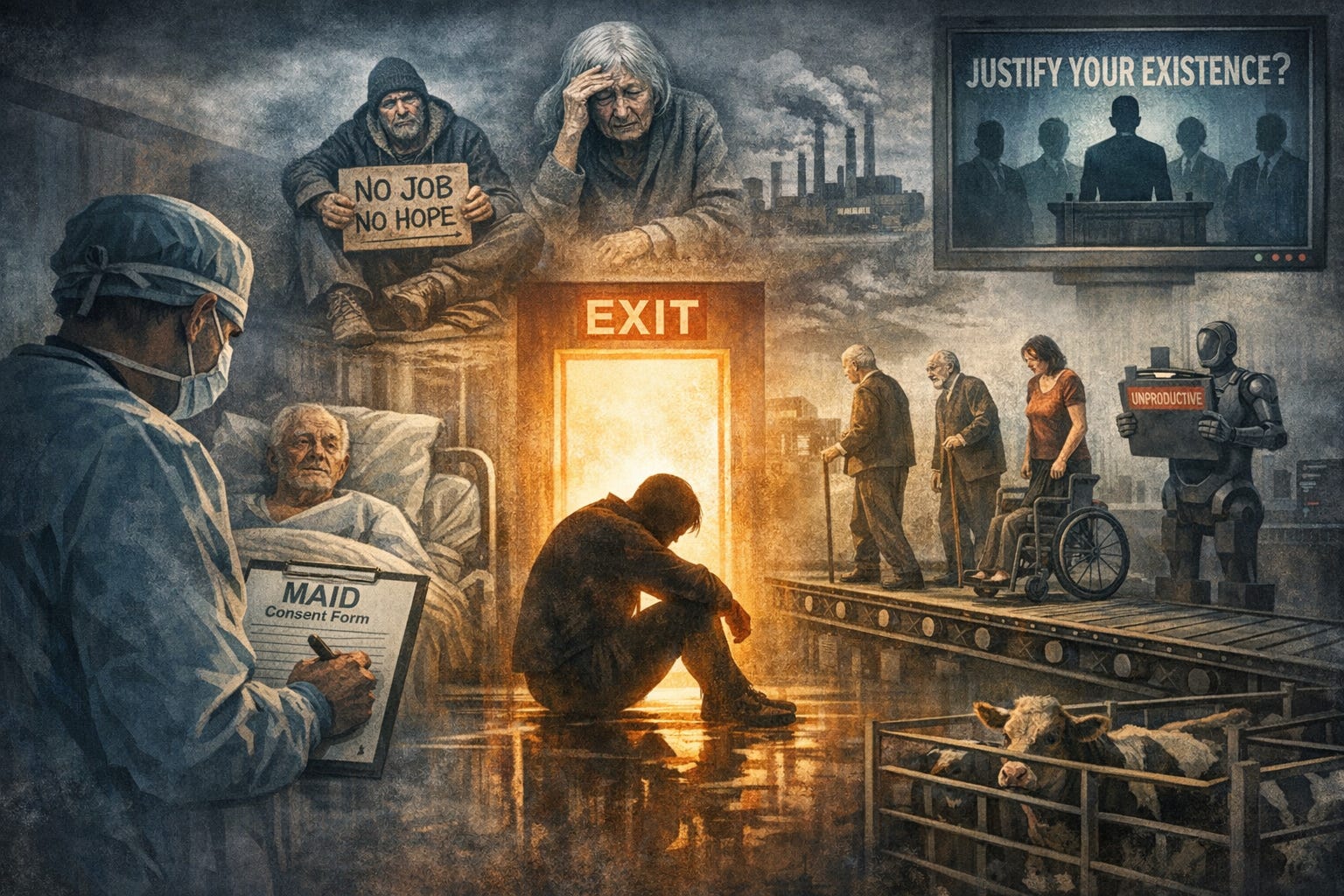
Certainly not the first time, but the recent reports about the “success” of Canada’s MAID program of state assisted suicide triggered a flood of thoughts. Chief among them is that it certainly seems an awful indictment of humanity that what credentialed “experts” describe as the advancement of civilization increasingly resembles something closer to devolution. I have long believed that for any change to be considered genuine progress, it must answer two basic questions in the affirmative: does it make humanity more special, and does it benefit all members of society, particularly the most vulnerable?
If the answer to either question is no, then what is being presented as progress may in fact be something else entirely. It is difficult, for example, to view the growing acceptance of elective—or even socially conditioned—euthanasia, such as Canada’s MAID program, as a positive development. In many respects, it appears to move us backward, reducing human beings to something closer to managed livestock than moral agents endowed with inherent dignity.
I have long nursed a growing sense—quiet at first, but increasingly difficult to ignore—that many changes being sold as “advancements” are not advancing humanity at all. What the expert class confidently promotes as progress often looks, on closer inspection, like regression: a steady erosion of human dignity, agency, and, in some cases, life itself. While every functioning society depends on specialized knowledge to some degree, somewhere along the way expertise has expanded beyond its proper domain. It no longer limits itself to technical questions; it now claims authority over moral ones.
That is where the trouble begins, because technical competence does not confer moral wisdom, and the assumption that it does can lead societies into decisions that are efficient, but not humane.
For most of our history—particularly within the Western tradition—progress was measured against a stable understanding of human worth. A society advanced not merely by becoming more efficient or technologically sophisticated, but by more faithfully protecting the inherent dignity of each person, especially the weakest. That standard imposed limits on what could be justified in the name of improvement. Today, those limits appear increasingly negotiable.
Consider the expansion of assisted death policies. Whatever one’s view of such measures in cases of extreme and terminal suffering, recent reports have raised deeply troubling questions. There are instances in which individuals have explored assisted death not because of medical conditions alone, but because of poverty, inadequate housing, or profound loneliness. In such cases, the issue is not simply that life is ending—it is that life has become too difficult to sustain, and that distinction matters more than we are willing to admit.
When a society begins offering death as a solution to conditions it has the capacity—but perhaps not the will—to address, something fundamental has shifted. The question is no longer simply about compassion; it becomes a question of what we believe a human life is worth when it is inconvenient, burdensome, or costly. Proponents argue from autonomy, framing such policies as an expansion of personal choice, a final assertion of control in the face of suffering. But autonomy, when untethered from any higher principle, can become something else entirely. If the standard becomes the elimination of suffering at any cost, then the logical endpoint is not merely the relief of pain, but the removal of the person who experiences it. That is not an expansion of human dignity; it is a redefinition of it, and a dangerous one at that.
The deeper issue is that suffering itself is being reclassified. It is no longer something to be endured, overcome, or alleviated through care, community, and responsibility. Instead, it is increasingly treated as a condition that renders life optional. Once that door is opened, it does not remain confined to the most extreme cases. It expands—slowly, bureaucratically, and often under the banner of compassion—through incremental normalization, where each step seems reasonable on its own, even as the cumulative effect becomes something far more consequential.
The Irish playwright George Bernard Shaw once suggested that individuals might be required to justify their existence, arguing that those who do not “produce as much as they consume” could not reasonably expect society to sustain them. His words reveal a line of reasoning that never fully disappears—the idea that human worth is contingent upon contribution. If that premise is accepted, even implicitly, the consequences follow naturally. A society that measures people according to productivity will inevitably find ways to categorize those who fall short. The elderly, the disabled, the chronically ill, and the economically marginal all become subject to a quiet recalculation of value.
Eventually, every socialist, Marxist, and communist society gets around to the question of tangible worth of an individual.
We are told such concerns are exaggerated—that safeguards exist, that this is about compassion rather than calculation. But recent history should give us pause. The guardrails we once assumed were permanent have proven far more flexible than advertised. The real danger is not that a government will openly declare certain lives unworthy. It is that we gradually adopt a framework in which such a conclusion no longer feels shocking, because the underlying assumptions have already been accepted.
Once human worth becomes conditional—based on health, independence, or perceived quality of life—it is no longer inherent. It is assigned. And what is assigned can also be withdrawn. A truly advanced society does not measure its progress by how effectively it eliminates suffering; it measures it by how it treats those who suffer. If we begin solving our hardest problems by redefining the people who experience them as expendable, then we are not progressing. We are retreating—away from the very principles that once made progress possible at all.
My husband and I really have prized your essays and thoughtfulness. We read them together and discuss the meaning to our lives.
My mother’s friend heard a knock at her door. When she opened it, there stood her X husband. He pulled out a pistol, put it to his head and shoot himself. In every case, suicide is mental illness. A society who fails to support the mentally ill is a society who has lost its way.