
When Citizens Became the Problem
The long transformation of American government from servant to master

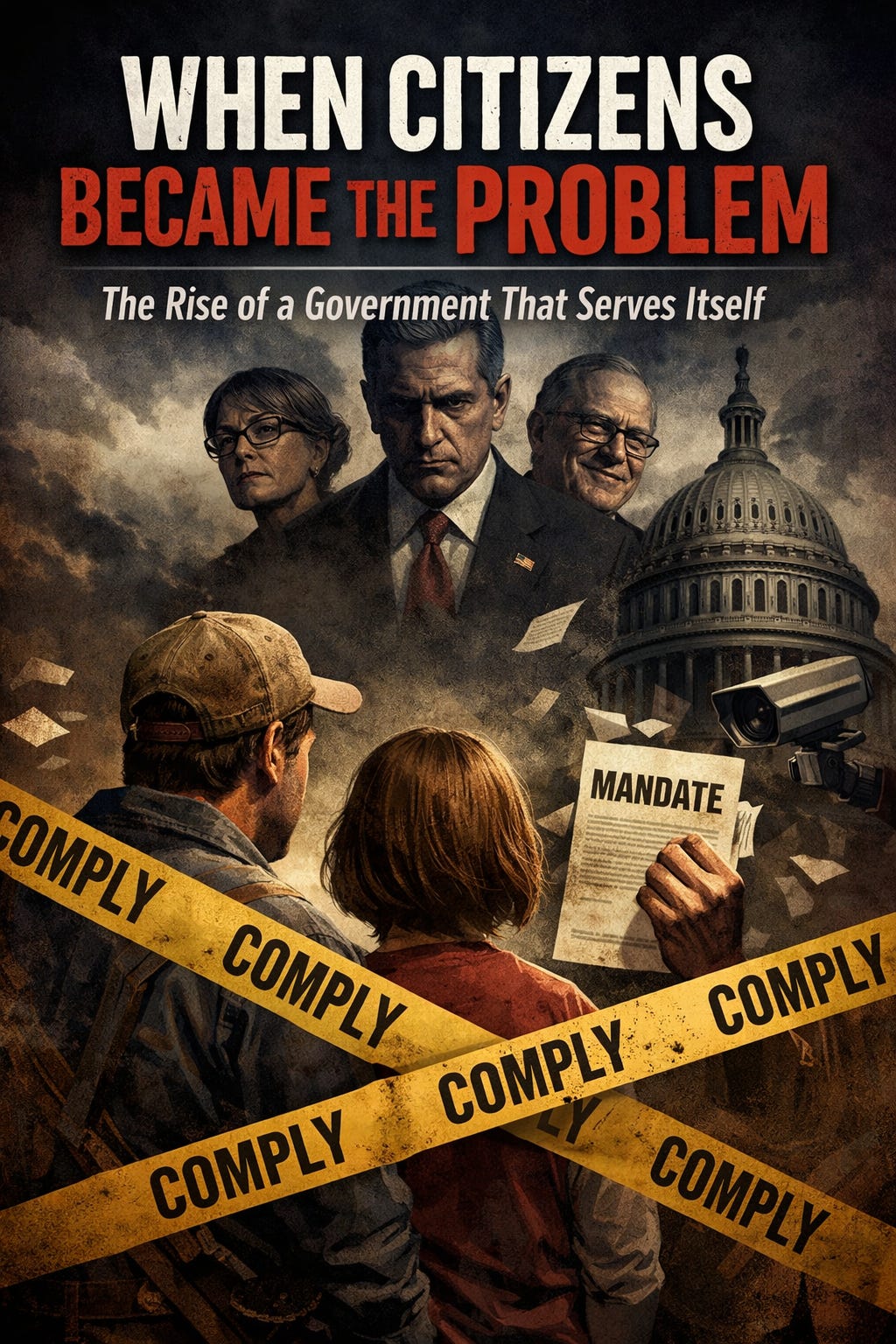
Admittedly, I have never conducted academic research on this particular organizational theory. What I have done for over more than four decades in business, is observe organizations form, grow, succeed, and decay. Across sectors—corporations, nonprofits, trade associations, and government agencies—the same pattern appears often enough to justify a general conclusion: most institutions pass through two distinct identity phases over the course of their lives.
In the first phase, organizations understand themselves as servants. Their success depends on meeting the needs of customers, members, donors, voters, or citizens. Growth is fueled by responsiveness. Authority is justified instrumentally, and legitimacy flows upward from those being served. In the second phase, that logic inverts. Having achieved scale, stability, and insulation from failure, institutions begin to believe that their continued success depends on their constituents serving them. Compliance replaces consent. Procedures displace outcomes. Preservation of the institution itself becomes the overriding goal, even when it conflicts with the interests of those it was created to serve.
Not every organization completes this transition. Some never leave the first phase; others flip remarkably quickly, as though they were merely waiting for sufficient size or security to reverse the relationship. Leadership matters, but structural incentives matter more. Once the second phase sets in, reversal is rare.
American government has followed this same trajectory.
For roughly the first eight decades of the republic, American governance largely reflected Abraham Lincoln’s formulation: government of the people, by the people, for the people. The state was limited not only by constitutional design but by self-conception. Its legitimacy rested on service. Its failures were visible. Its scope was narrow enough that incompetence and corruption, while present, were constrained by scale.
The Civil War disrupted that equilibrium. War inevitably expands state power, and Reconstruction required the victors to impose authority over the defeated. Whatever its moral intentions, Reconstruction undeniably accelerated federal centralization and normalized a more permanent administrative presence in American life. The federal government emerged larger, more intrusive, and less restrained by precedent than it had been before the war. That expansion altered the relationship between citizen and state, creating new bureaucracies, new dependencies, and new opportunities for corruption that would persist long after Reconstruction itself ended.
In my reasoned opinion, Reconstruction created a new class of people to victimize and also spawned a new class of criminals, most operating in conjunction with government or as part of it, who were more than willing to exploit them (think the Lollipop Guild currently running the state of Minnesota).
By the late nineteenth century, progressive and socialist ideas gained traction, fueled by industrialization, immigration, and urbanization. The decisive break came with Theodore Roosevelt’s accession to the presidency in 1901. Roosevelt’s progressivism was not initially authoritarian; it framed government expansion as a means of improving ordinary life. But it decisively shifted the federal government out of its servant posture and into a managerial one, treating administration not as a necessary evil but as a positive good.
Woodrow Wilson completed the transformation. Wilson was not merely a progressive but an ideological authoritarian who believed democracy required direction by enlightened elites. In his view, the masses were too uneducated and unsophisticated to govern themselves—a belief that informed both his racial policies and his theory of governance. More consequential than Wilson’s personal prejudices was the governing template he established. He normalized the idea that progress required administrative control, expert management, and moral supervision by the state. Constitutional limits became obstacles. Consent yielded to outcomes defined by those in power.
Subsequent expansions of federal authority—under Franklin Roosevelt, Lyndon Johnson, and Barack Obama—followed this Wilsonian blueprint. Each framed government growth as benevolence. Each increased dependency. Each further inverted the citizen-state relationship. There were interruptions. Calvin Coolidge resisted the progressive impulse and briefly returned government to a service posture. Donald Trump represented a more recent disruption, not by systematically dismantling bureaucracy but by challenging its moral authority. Yet, most Republican presidents retained traces of Theodore Roosevelt’s progressive DNA, advancing the same institutional logic at a slower pace.
The result is a government firmly entrenched in the second phase of organizational life. Its success is measured less by service delivered than by compliance secured. Citizens are expected to serve the administrative state—by funding it, deferring to it, and accommodating its failures—rather than the reverse. The modern Democratic Party remains dominated by Wilsonian assumptions: that enlightened officials must manage society, that dissent reflects ignorance, and that institutional authority confers moral superiority. The Republican Party, though less ideologically committed, has rarely challenged the underlying framework. I fear we see them reverting to type right now.
This shift represents more than political evolution. It is a structural inversion. When institutions stop asking “How can we serve?” and start asking “How can they serve us?” they cross a threshold that is difficult to reverse. Accountability erodes. Corruption becomes systemic. Citizens cease to be stakeholders and instead become obstacles to administrative efficiency.
What we are experiencing is not the inevitable entropy of democracy. It is a predictable lifecycle failure. And what is predictable can, at least in theory, be interrupted. Every generation inherits institutions somewhere along this arc. The question is whether we still possess the clarity to recognize when service has given way to self-preservation—and the will to force our institutions back into the role they were meant to play, before the inversion becomes permanent.
Well said.