
Water From the Well
Of hogs, troughs, leaks and buckets - more lessons from one of the wisest men I have ever known, my Mississippi granddaddy, Baker T. Goodwin.

Incrementalism is one of the most dangerous of social and financial activities—largely because it can happen intentionally or unintentionally—but the outcome is equally as disastrous.
I have personally experienced unintentional incrementalism.
I began my “outside the farm” working career in the spring of my 9th grade year (after I received my driver’s license). I had always worked around our farm, taking care of animals and working in our fields but I landed a part time, after school and Saturday morning job from which I began the long sad saga of paying taxes. My wife and I were looking at my Social Security records, and I officially began paying SS “contributions” in 1974.
I made enough to pay for my car expenses with a fair amount left over, but I never could seem to save very much. After a few months, my granddaddy asked me how work was going and if I was putting money back in savings and I complained that I just wasn’t making enough to save very much. He sat with me and we looked at one of my latest bank statements and it was pretty clear – I wasn’t spending on anything big, but I was eating out a lot, going to the movies every weekend, and since I had a car and some of my friends didn’t, I was running around a lot and burning gas. He pointed out to me something his father told him—and it was an old English proverb that went like this:
Take care of the pence, and the pounds will take care of themselves.
Meaning of course, watch your pennies and the dollars will be fine. It was the multitude of small expenses I was paying that were adding up to something big—or more accurately, a big nothing at the end of the month. He reminded me that nobody pays as much attention to a small leak in a hog trough as they do if the hogs overturn it because everybody notices a big event like that—but constant, small leaks don’t seem as important but often waste more water over time than the tank holds. It is better to stop and plug the leak – or get a new trough.
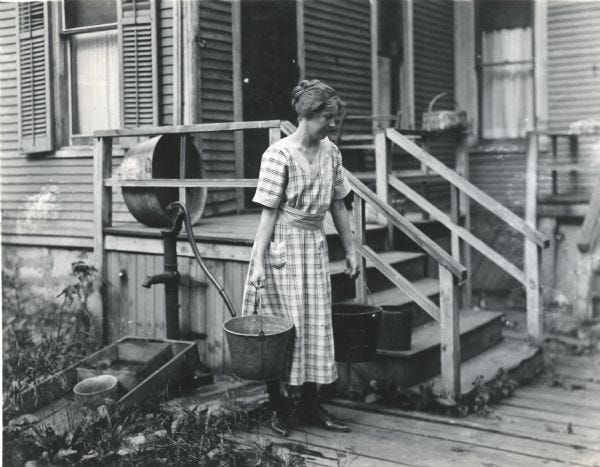
He was from a time when water was hauled out of an open well with rope and a bucket and said that while the farmer might not recognize the small leak, the kid who had to haul buckets from a well some distance from the barn will certainly know. He recommended that I set out a portion of my weekly earnings in cash for my own spending but leave the rest of it alone. That way, I would be more focused on how many buckets I was carrying and where my money was going.
We see intentional incrementalism in government all the time. Every million-, trillion- and billion-dollar policy and program is subject to politicians wanting to spend just a little bit more to help this person or cover this particular condition—and it usually gets done because the expansion looks so small in comparison to the total cost—but over a few years, thanks to the miracle of compounding, before you know it the spending has doubled or tripled.
Lots more buckets taxpayers must carry to keep the government trough filled.
The fact is that everybody wants “free” stuff and it is virtually impossible after the free stuff spigot gets turned on to turn it off.
But as anyone who has had an Econ 101 class knows, there is no such thing as a free lunch. Somebody, somewhere, at some time, must pay.
And today, it isn’t just money, increasingly the idea of “free stuff” applies to behaviors as well—this incrementalism has extended to “Get out of jail free” cards, too.
How does it stop?
Hard to do when people understand they can just vote for people who will keep the party going. As with my friends, everybody was ready to go places until I started asking them to share the cost of the gas it took to get there. We didn’t know it at the time, but they all were guilty of moral hazard because they were behaving differently when they weren’t exposed to the reality of what gas cost—because I was paying for it.
In truth, this is how it stops – we must do what I did in 1974 and ask for gas money. Last week I didn’t propose that everybody should pay income taxes and we should tighten up eligibility for programs like SNAP, AFDC, and Obamacare subsidies because I hate poor people, it was simply for the purpose of stopping the intentional incrementalism by making the cost of the gas visible and assure everyone has some skin in the game.
It seems that every year that while the leak in the hog trough gets bigger, there are fewer people hauling bigger and bigger buckets of water to keep the trough full.
Folks are getting tired of hauling water and the solution isn’t to get bigger buckets.
About 15 years ago, various political talk shows began pushing “the Fair Tax” as a way to end income taxes. It was simply a proposal that we set up a national sales tax that taxed everything sold except food, medicine, fuels and electricity. Clothing was exempted up to $100 per item but taxed on the amount above the exemption. As I recall, there was to be no tax on services.
Some proposed applying the tax to purchase of bonds, and other investments like stocks but that was unsupported by almost all.
I wonder if, in light of The Trumpeter’s focus on tariffs, if this old plan might be revisited.
US real estate taxes will increase to supplement for the loss of income taxes.
Only the plebes and peasants without property will be entertained and content with the end of income taxes as non own private property anywise.
YOU WILL OWN NOTHING AND BE HAPPY.