
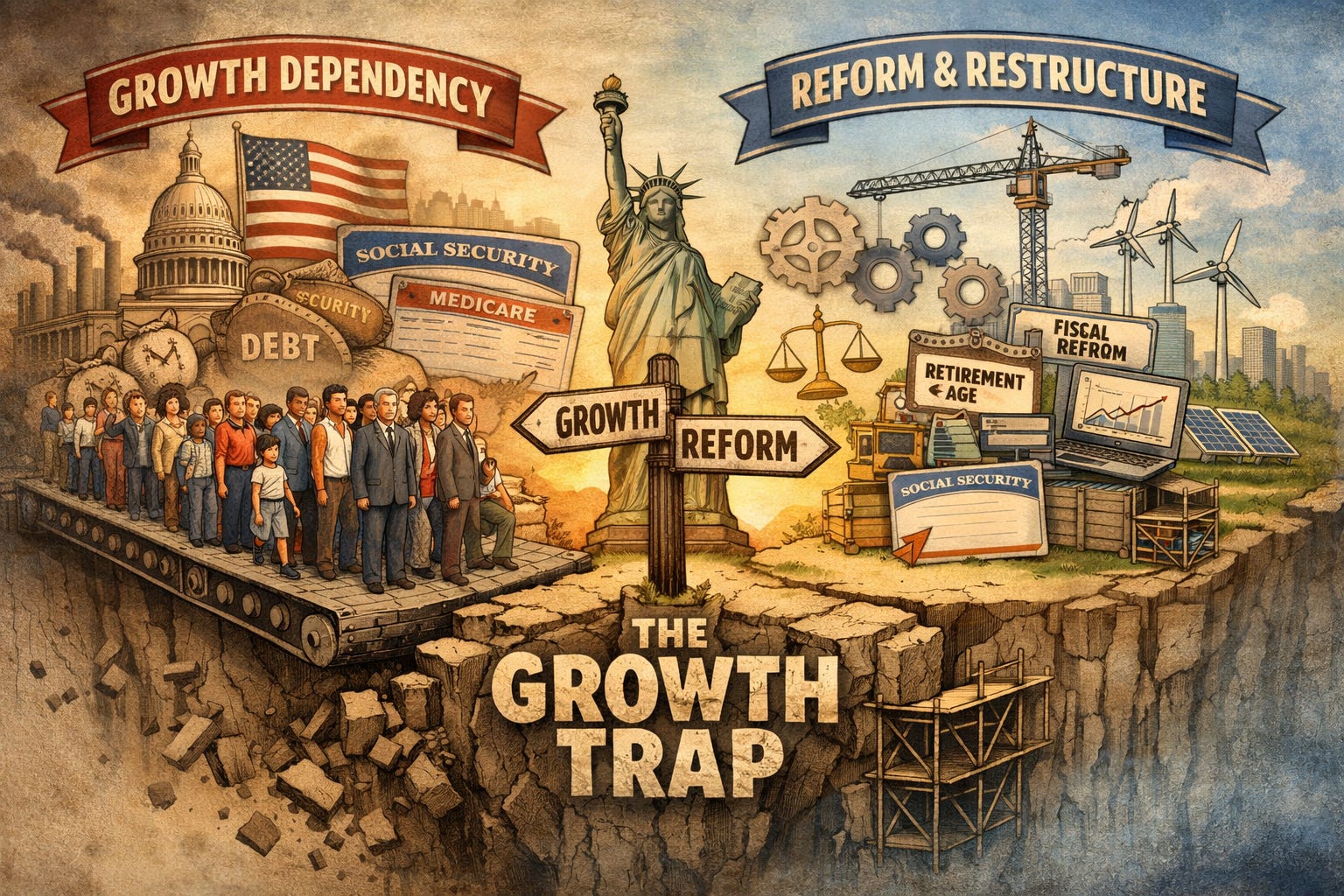
The Growth Trap
Does population growth drive larger government or does government just need more people to pay for its expansion?

Immigration activists argue we need massive immigration because there aren’t enough field workers to pick their arugula and avocadoes for their morning toast, clean their bathrooms, or trim their lawns. Libertarians argue we don’t have enough people to power our industrial base. Now state leaders like Kathy Hochul in New York are begging for the Richie Riches she told a couple of years ago to jump on a bus and head for Texas or Florida to come back — so she can tax them to pay for the generous social programs NY intends.
We have grown accustomed to thinking of population growth as a sign of national health. More people mean more workers, more consumers, more taxpayers — more of everything that keeps a modern economy humming. For most of American history, that assumption was not only true but foundational. A young, expanding nation with abundant land and opportunity could absorb wave after wave of new citizens and turn that growth into strength.
A couple of questions worth asking, especially now that America is fast approaching her 250th birthday:
Does government grow because we have more people, or do we simply need more people because the ruling class wants to grow government? Is America a nation that grows because it is strong, or just a nation that must grow to avoid confronting the consequences of decisions made decades ago?
At its core, the American system is still built on growth. Programs like Social Security and Medicare were designed in a very different demographic reality — when many workers supported relatively few retirees. The math worked because the base of the pyramid was always expanding. Each new generation was larger than the last, and the system depended on that expansion to remain solvent.
That is no longer the case.
Today, the ratio of workers to retirees is shrinking, and it will continue to shrink as the population ages. Yet instead of restructuring these systems to reflect that reality, we have largely chosen to maintain them as they are — hoping, implicitly or explicitly, that continued population growth bridges the gap. Immigration has become a kind of demographic backfill, a way to add new workers and taxpayers into a system that was never redesigned for a slower-growing or stable population.
Which brings me back to that uncomfortable question.
In the private sector, this wouldn’t even be controversial. Businesses constantly seek greater efficiency. They automate, streamline, and reduce headcount where possible — producing more with fewer people. Productivity gains are celebrated precisely because they allow output to increase without requiring constant workforce expansion.
Why should a nation be any different?
The answer is that a nation is not a business. A business exists within a broader system; a nation is the system. When a company reduces its workforce, it still relies on a growing population of customers, infrastructure, and economic activity beyond its walls. A country that reduces its population isn’t just trimming excess — it is altering the very foundation of its economy and society.
Fewer people means fewer workers, but also fewer consumers, fewer homebuyers, fewer entrepreneurs, fewer taxpayers. Entire communities can hollow out. Economic growth slows — not because productivity has declined, but because there are simply fewer participants in the system. We are already seeing this in Japan, where population decline has produced decades of economic stagnation despite high levels of technological sophistication.
Of course, the alternative — perpetual growth — comes with its own costs.
A system that depends on constant expansion begins to resemble a treadmill. It must keep moving forward simply to stay in place. Each new cohort of workers isn’t just contributing to current prosperity; it is being asked to support an ever-growing set of obligations accumulated over time. Growth becomes less about opportunity and more about maintenance. The nation is no longer expanding because it chooses to — it is expanding because it must.
This is the growth trap.
The real issue is not whether more people are inherently good or bad. It is whether the structures we have built can function without continuous expansion. If they cannot, then population growth ceases to be a sign of vitality and becomes a requirement for stability — a fundamentally different proposition.
There is, in theory, another path: a steady-state model in which population stabilizes and productivity, rather than sheer numbers, drives prosperity. But such a model would require difficult and politically unpopular reforms. Retirement ages would need to rise. Benefits would need to be adjusted. The entire fiscal architecture would have to be recalibrated for a world in which contributors are no longer perpetually increasing.
These are not technical challenges. They are political choices.
It is far easier to add new participants to the system than to renegotiate the terms of the system itself. Growth allows us to defer those decisions — to smooth over imbalances that would otherwise demand immediate attention. But deferral is not resolution. At some point, the underlying math asserts itself.
What we are experiencing now is the tension between these competing realities. Our policies still assume growth, but our demographics are drifting toward stability, if not eventual decline. We are attempting to operate a growth-dependent system in a world that may no longer support it.
That is why the question of population feels so unsettled.
It is not simply about numbers. It is about whether we are willing to rethink the assumptions that have governed the American system for generations — or whether we will continue to rely on growth, organic or imported, to carry forward a structure designed for a different time.
The choice is not between more people and fewer people. It is between reform and dependency.
A nation that chooses reform can adapt to a stable or even declining population. A nation that avoids it must continue to grow, whether it truly needs to or not. That is a significantly different kind of growth than the one that built America.
There is a similar dynamic in housing - everyone how owns wants their home to go up in value. Everyone that wants to buy a house wants the market to be more affordable. Those are two irreconcilable priorities - so naturally government policy tries to do both.
We are about to see an absolutely unprecedented expansion of productivity as AI becomes more capable and moves into the physical realm. We're going to have to figure out how to tax robots because humans won't be collecting taxed paychecks.