
The Great Confusion
More often than ever when people ask me where I think we are going as a nation, my answer is a confident "I don't have a clue."

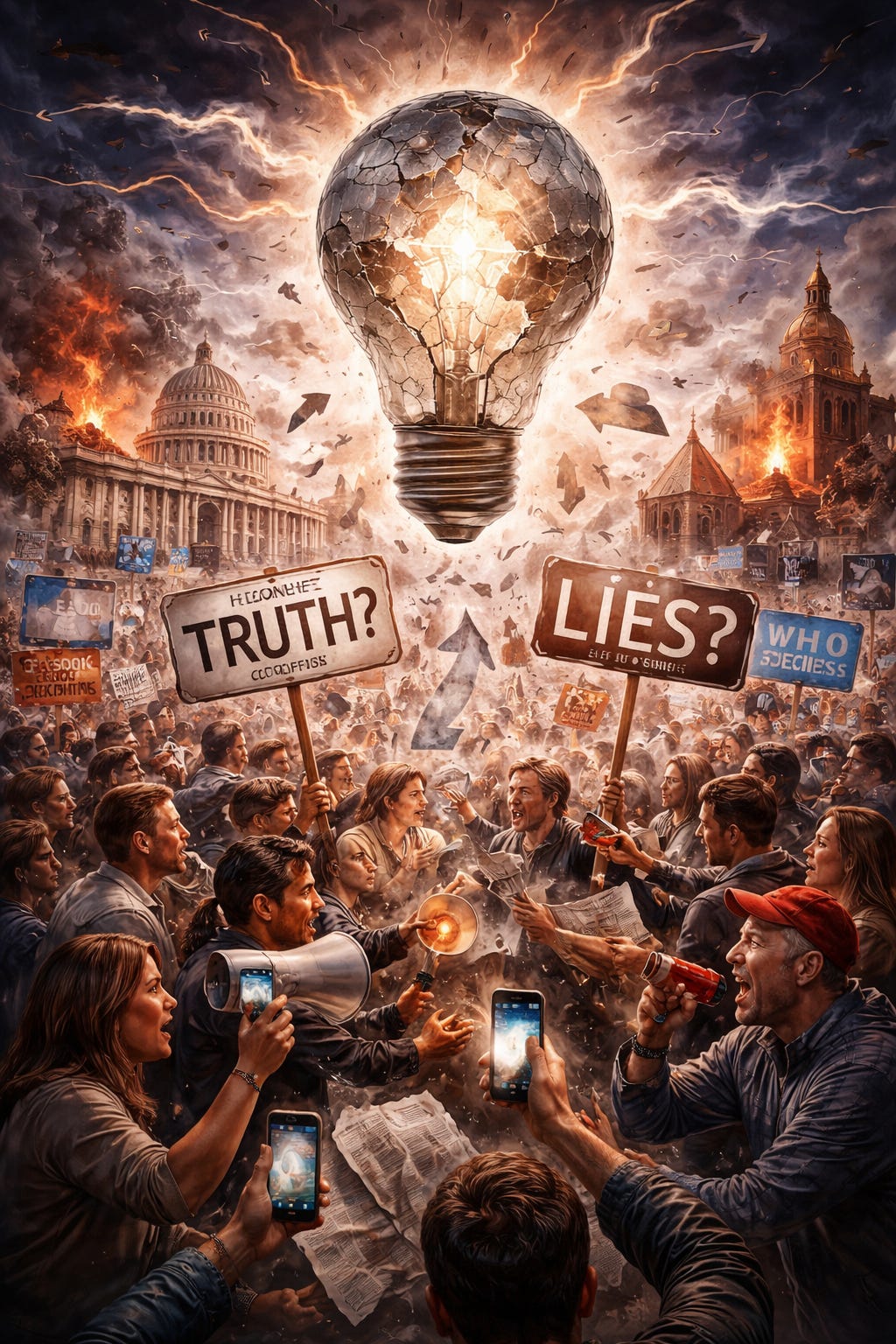
Like it or not, the election of Donald Trump in 2016 fractured the old sociopolitical order in America —and a decade later, we still haven’t figured out what that means.
It is difficult to describe exactly what is happening to our social and political order, but something fundamental is clearly shifting beneath our feet. Institutions that once organized society are fracturing. Long-standing assumptions about family, religion, nation, and truth are being rejected or redefined. Schism seems to be everywhere, and even the most basic organizing principles of social life appear to be dissolving.
Not long ago, a “family” was generally understood to mean a mother, a father, a couple of children, and perhaps a dog running around the yard. Today the definition can mean almost anything. Religion, once a central pillar of Western civilization, has become passé in many circles unless it is fused with a political ideology, but the deepest shift is not about family structure or religious observance. It is about truth itself. We are no longer merely arguing about what is true. Increasingly, we are arguing about whether objective truth exists at all.
I’ve taken to calling it The Great Confusion.
Political identity has become almost unrecognizable. People who once occupied relatively stable ideological ground now seem to mutate into strange hybrids. Figures once seen as rational conservative voices—people like Tucker Carlson, Candace Owens, and even Megyn Kelly—now flirt with rhetoric that drifts toward conspiratorial thinking or antisemitic tropes. On the other side, liberals who once framed themselves as defenders of civil liberties now openly advocate authoritarian solutions to social and political problems: censorship regimes, speech restrictions, bureaucratic enforcement of ideological compliance, and the collectivization of social norms.
The language is raw, the hostility explicit, and the mutual distrust nearly absolute.
The weird part is that there seems no coherent ideological struggle between competing visions of governance, it is something closer to fragmentation. Political labels that once provided orientation—conservative, liberal, libertarian, progressive—are steadily losing meaning. People move between positions with dizzying speed, alliances form and collapse overnight, and entire political communities increasingly seem defined less by what they believe than by whom they despise.
I am certainly not a professional historian, but I have read enough history over the years to know that moments like this are not unprecedented. The late Roman Republic experienced something remarkably similar. For centuries Rome had been governed by a stable system of customs and institutions. Senators might argue fiercely, but they still shared a basic understanding of how the political order functioned. Eventually those assumptions began to break down. Norms were ignored, political factions hardened, and rhetoric grew increasingly apocalyptic. Romans themselves complained that the old order no longer worked, yet no one could agree on what should replace it.
Europe experienced another version of this confusion during the Protestant Reformation. For nearly a thousand years, religious authority flowed through a single institutional structure. Then the printing press shattered that monopoly almost overnight. Competing interpretations of truth flooded the public sphere and religious wars followed. People were no longer merely debating doctrine—they were arguing about who had the authority to define reality itself.
The early twentieth century offers yet another example. In the years between the world wars, political categories across Europe dissolved into strange and often dangerous combinations. Nationalists borrowed socialist rhetoric, socialists adopted authoritarian methods, and liberal democracies struggled to defend their own principles. Political language itself became unstable.
Periods like these share a common feature: the collapse of trust in institutions that once mediated truth and authority.
When institutions fail, or when large numbers of people lose faith in them, society inevitably enters a period of intellectual turbulence. The normal mechanisms that help distinguish truth from error begin to break down. Authority becomes diffuse, and everyone increasingly sees himself as his own arbiter of reality. Competing narratives proliferate, expertise is dismissed as propaganda, and conspiracy theories flourish because they offer simple explanations for a complicated world.
The result is the kind of social atmosphere we inhabit today—an environment saturated with information but starved for credibility and trust. People encounter an endless stream of claims, counterclaims, and interpretations, yet fewer institutions remain that command broad confidence as honest brokers of truth.
It is like driving across the country with no road map and only a compass to guide us.
Modern technology—particularly the internet—has accelerated this process in much the same way the printing press did during the Reformation. It shattered the gatekeeping power once exercised by media organizations, universities, and traditional cultural institutions. That democratization of information brought many benefits, but it also removed many of the stabilizing filters that once shaped public discourse. Ideas now circulate instantly and globally, often stripped of context, verification, or restraint. A claim can reach millions of people long before anyone determines whether it is accurate, misleading, or entirely fabricated. The most inflammatory interpretation of events often travels farther and faster than the most measured one.
History suggests that periods like this rarely resolve themselves quickly. Rome’s political crisis unfolded over nearly a century before the republic finally gave way to imperial rule. Europe endured generations of religious conflict before the modern state system gradually stabilized authority after the upheaval of the Reformation. The ideological turmoil of the early twentieth century stretched across decades before a new political equilibrium emerged.
That does not mean our present moment must follow the same path. History never repeats itself perfectly, but it does suggest that confusion is often the opening stage of large-scale political and cultural realignment.
When the old order loses legitimacy and the institutions that once anchored social consensus no longer command trust, society enters a kind of intellectual interregnum—a transitional period in which established norms dissolve faster than new ones can be created to replace them.
The Great Confusion is not simply a disagreement over policy or politics. It is a deeper struggle over the foundations of meaning itself, truth, authority, identity, and legitimacy. Until those foundations stabilize again, the strange alliances, ideological mutations, and social fragmentation we see today will likely continue.
What comes next?
The truth is no one really knows.
I sure as hell don’t.
“Confusion will be my epitaph.” — King Crimson
I think they were onto something.
What we’re witnessing isn’t random chaos—it’s textbook ideological subversion. Yuri Bezmenov laid it out decades ago when he described the Soviet strategy for weakening the West. Phase one was demoralization. Phase two was destabilization: attack the economy, fracture institutions, pit citizens against each other, and blur the very concept of truth. Sound familiar? Moscow and Beijing understood that you don’t defeat America with tanks—you rot it from within. Flood the culture with division, erode trust in family, faith, and nation, and weaponize media and academia to amplify the confusion. The “Great Confusion” isn’t an accident. It’s the predictable outcome of a long-running destabilization campaign against Western civilization.