
The Fight We Fight
Is it morning in America or simply mourning among the ashes?

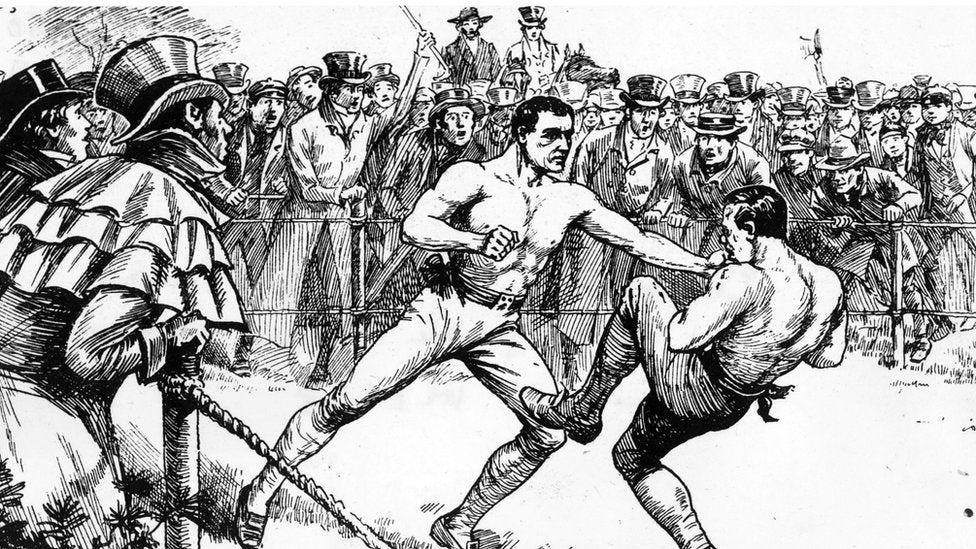
I see Trump as fighting – granted, sometimes unconventionally and haphazardly so - to return America to its halcyon days of reason, civility and rule of law. It is our fight as well.
Without fear of contradiction, I will state what Democrats are fighting for in America is not a “return” to anything, it is something that has never been. It isn’t managed decline they seek, it is “managed” freedom, which is to say no freedom at all. Decline is simply a byproduct.
In many ways, this is a fight to the death.
To be intellectually honest, we must look at both sides of any question and be brutally clear about the possible outcomes, which leads me to ask something I have been thinking about since Obama was elected in 2008:
Do you suppose the Romans knew the precise moment Rome began its slide to destruction?
Some things are only visible in retrospective – history is always a lagging indicator.
So, what if Trump’s battle to restore reason, civility, and the rule of law fails? What if America, and Western civilization itself, are already lost, leaving us to wander among the ashes of a once-great society?
These questions haunt our polarized age, echoing the Federalist Papers’ warnings about factionalism and the fragility of republics. As we ponder whether the Romans knew when their empire began its slide, we must ask: are we too blind to our own decline, or can we still fight for renewal?
The Federalist Papers, penned by Hamilton, Madison, and Jay, offer a timeless lens for this crisis. In Federalist No. 10, Madison argues that a large republic tempers irrational passions through diverse representation, ensuring reason prevails over mob rule. Trump’s supporters see him as a champion of this clarity - battling “woke” ideology, bureaucratic overreach, and a politicized justice system.
If he loses this fight, whether in elections or cultural influence, the Federalist Papers suggest hope lies in the system’s design. Federalist No. 78 champions an independent judiciary to uphold the rule of law, while No. 52 trusts frequent elections to renew accountability – but given the stances of the radical judges sitting in the various Article III District Courts, Hamilton’s idea of an impartial, independent judiciary seems wishful thinking at this point.
What if the rot runs deeper? The fear that America and the West are “already lost” resonates with those who see declining birth rates (1.6 in the U.S.), institutional distrust (only 20% trust government, per Pew), and cultural fragmentation as terminal. On social media, users lament everything from open borders to DEI mandates, viewing them as symptoms of a civilization unmoored from its founding principles. The Federalist Papers warn of such perils: No. 10 fears factions tearing republics apart, and No. 55 stresses that civic virtue is the bedrock of self-governance. If Americans are too divided or apathetic, no structure can save us. Yet, the Papers remain optimistic, emphasizing adaptability through amendments (No. 43) and checks (No. 51). The Federalist Papers’ faith in human agency (No. 1) suggests decline isn’t fated. The West’s resilience suggests we’re not yet in ashes.
Thomas Jefferson penned my greatest worry about mankind’s surrender in the Declaration of Independence when he stated that “all experience hath [shown] that mankind are more disposed to suffer, while evils are sufferable than to right themselves by abolishing the forms to which they are accustomed.”
Did Romans know their empire’s tipping point?
No.
Decline was a slow bleed - overexpansion in the 2nd century, military chaos in the 3rd, barbarian invasions by the 5th. Writers like Tacitus decried moral decay, but others, like Constantine, bet on renewal. The 476 AD fall was clear only in hindsight; life persisted under new rulers. Today, we’re equally blind. Social media debates over “collapse” pinpoint symptoms - debt, polarization - but miss the broader arc.
If Trump’s offensive falters, the fight for reason and law endures. The Stoics, writing amid Rome’s crises, urged focusing on what we control: our choices, our virtues. The Federalist Papers echo this, calling for deliberate effort to sustain a republic. We’re not yet among ashes, but the stakes are clear. History shows civilizations reinvent themselves; post-Roman Europe birthed the Renaissance. While Trump’s win changes the trajectory of America, his defeat could spark new movements, provided citizens refuse to surrender.
Whether we are Rome in 200 AD or 476, the lesson is agency. Reason and the rule of law are worth defending, not just for Trump’s sake, but for the civilization our descendants will inherit.
Good analysis. Our time to reverse is short. I'm not confident the societal will exists for the battle.
I don't believe all is lost in the battle ... coming back will take effort and time. As Mr. Richmond commented, societal will is important. Teaching history as a "required" for high school matriculation may well help reinforce that. We have too many amongst us who do not know the wisdom of the Federalist Papers