
The Discussion Continues
In which I disagree with a Senior Fellow at the Foreign Policy Research Institute.

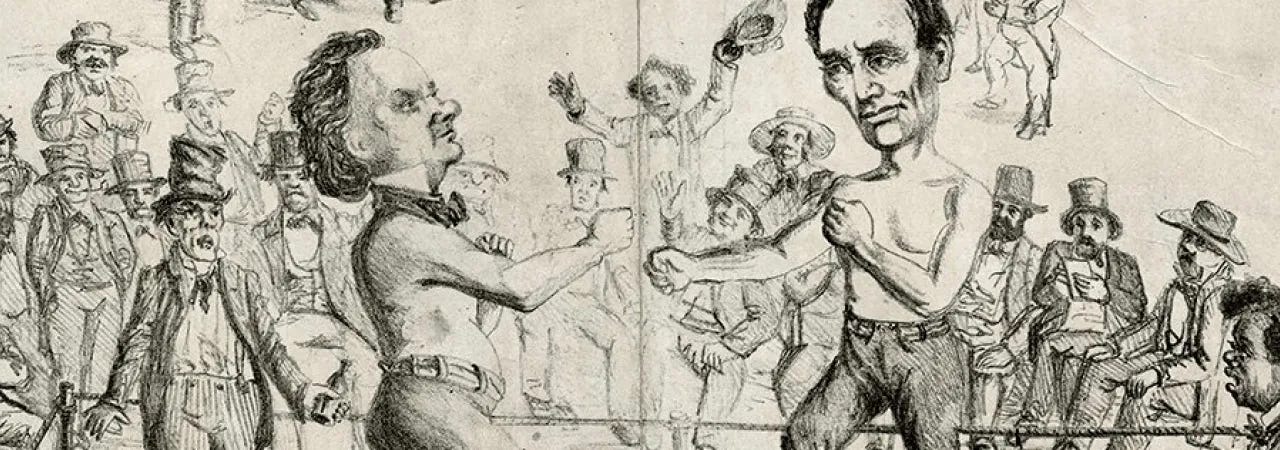
My Facebook friend, Mackubin Owens, a legit military history, and foreign policy expert, and I are at odds about my essay regarding the damage done to the federalism envisioned by the Founders. My friend asserts that Lincoln returned the US to roughly the way it was ante bellum and the progressive movement did the real damage.
My essay argued, not that the Civil War was THE cause, but that the evolution of today’s form of centralized federal governance was enabled and given a boost by the policies enacted by the United States during and after the Civil War.
We certainly agree about the impact of progressivism, but I would assert that the Civil War and its aftermath – including the repressive Reconstruction Era – set the table for the progressive movement in America and established a permission structure that allowed things that would not have stood in the first 80 years of the American Republic to be enacted.
Reconstruction "ended" in 1877, and the US Progressive movement got its start in the 1880's through ideas imported from Europe. I would argue that many Reconstruction policies as they were applied to the South were simply incorporated in the US Progressive Movement as the basis of policy.
While the Civil War’s aftermath created conditions for adopting European progressive ideas, some argue that the Progressive Movement was primarily a homegrown response to American industrialization and political corruption and it is true that the Populist Movement of the 1870s and 1880s, rooted in agrarian discontent, predated the Progressive Movement and addressed similar issues without significant European inspiration. However, the intellectual and policy parallels between European progressivism and American reforms—particularly in bureaucracy, labor, and urban planning—suggest a strong transatlantic influence, amplified by the post-Civil War expansion of federal power.
Some specific examples include:
The professionalism of the bureaucracy per German administrative models, rooted in Prussian reforms, inspired a professional, merit-based civil service, influencing figures like Woodrow Wilson, who advocated for bureaucratic efficiency in his 1887 essay “The Study of Administration.” This led to the Pendleton Civil Service Act of 1883, which introduced merit-based federal employment to manage post-war federal responsibilities like pensions and infrastructure.
British social reforms, including Fabian socialism and the Liberal Party’s initiatives under William Gladstone, promoted state intervention to improve working conditions, influencing U.S. labor reforms like factory safety regulations and child labor laws, seen in state labor bureaus (e.g., Massachusetts) and early legislation in Illinois, modeled on Britain’s Factory Acts (1833–1878).
Similarly, Otto von Bismarck’s German social insurance programs of the 1880s, offering health and pension benefits, inspired Progressive-era reformers like Jane Addams and the American Association for Labor Legislation (founded 1906) to push for workers’ compensation laws, adopted by over 30 states by 1917.
British urban planning, including the Garden City movement, influenced the U.S. City Beautiful movement, exemplified by Chicago’s 1909 Plan, which embraced centralized planning to address urban overcrowding and sanitation.
European progressive ideas, rooted in the 19th-century liberal and socialist movements of Britain and Germany, emphasized government intervention to address social and economic problems, bureaucratic efficiency, and scientific approaches to governance. These ideas found fertile ground in the U.S. Progressive Movement, which sought to regulate corporations, improve labor conditions, and expand democratic participation.
Perhaps a difference of perspective between a man who is a senior fellow at the Foreign Policy Research Institute, and that is just one of his many accomplishments, and a victim of the Mississippi Public School and state University System, is not a battle to wage, but I’m a little hardheaded.