
The Democrats' Middle Class Problem
Why modern progressivism can’t succeed unless Americans stop prospering.

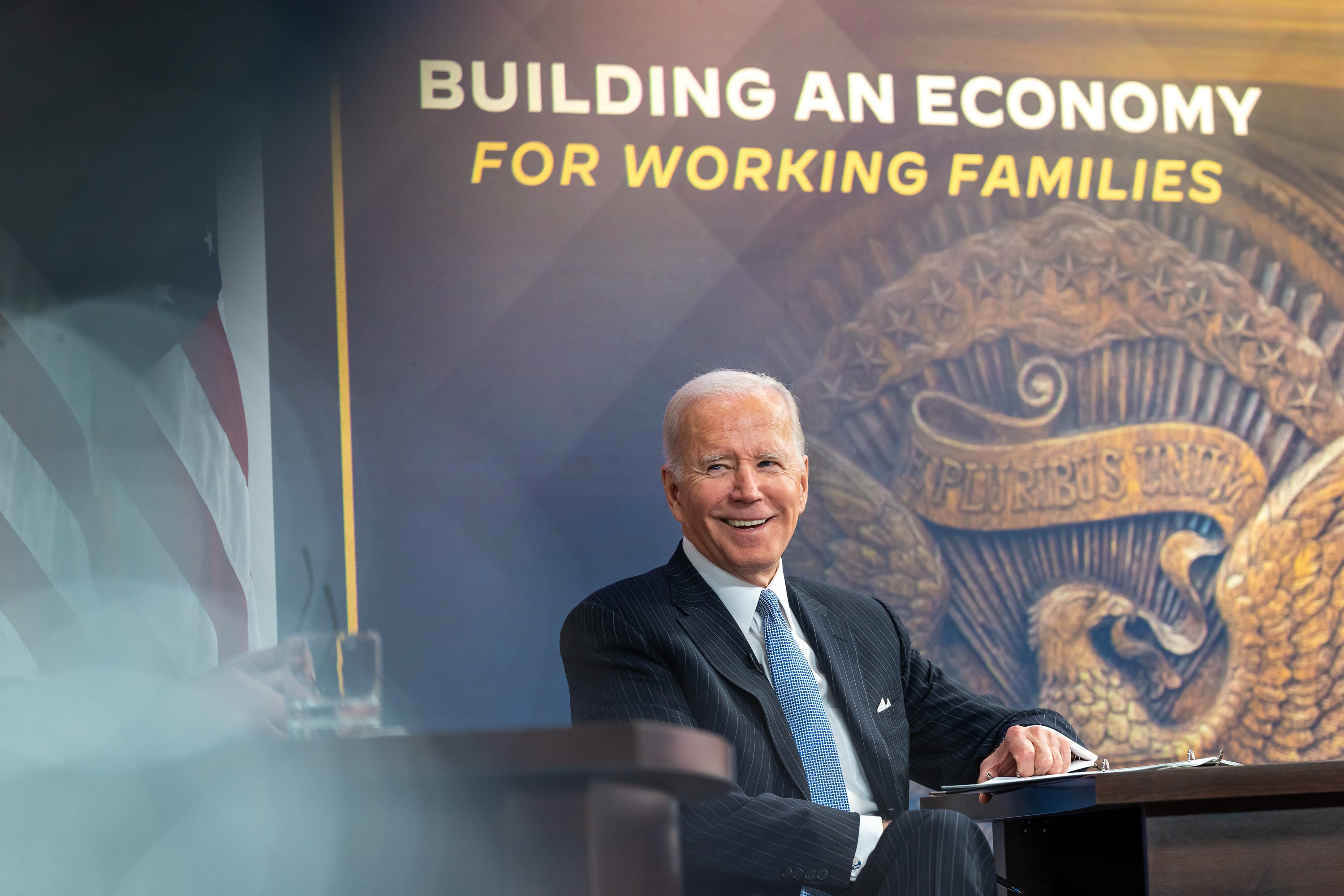
Remember the “building from the middle out and from the bottom up” sloganeering of the Biden campaign?
Yeah, they didn’t really mean that.
The greatest scam the contemporary Democrats, the party now drawing political inspiration from Bernie Sanders (a man who, like Marx, has never produced a damn thing), has, is, and will, ever perpetrate on the American public is that they are the party of the middle class—or that they give a damn about middle class Americans (other than on election day).
If you listen to them talk, if you can survive the assault on your brain their word salads represent, you know they talk a good game about “soaking the rich” when they, themselves, are richer than you. Democrats will make a show about taxing wealth (taxing unrealized gains) but if the rich retain the mobility to move their businesses and themselves out of those jurisdictions, that will never go anywhere. Even for the stupid ideologues who remain in states planning such taxation, it will be a one-time thing just to prove they can do it. It’s mostly a show for the lower class they plan to create.
The policies of the “democratic socialist” wing of the Democrat party are patently anti-prosperity, economically harmful, punitively redistributive, economic wars on the very people they claim to champion.
They know the social and economic mobility of the American middle class is the chief impediment to their goal of an authoritarian, technocratic, bureaucratic, communist state—with them in charge.
I recall reading about an exchange a long time ago—it might have been when Western researchers were granted access to Soviet archives after the Berlin Wall fell, I don’t recall— about a reported discussion between Soviet era operatives planning their attacks on American capitalism. The discussion was about why their subversive efforts were not working during the social upheavals of the 1960’s because they thought the American public should be storming government buildings and demanding collectivism be implemented immediately.
One of the participants said that a Soviet like “people’s revolution” would never work because the American middle-class was too prosperous and happy. He noted that holidays for the average middle class home included feasts and gift exchanges reserved only for the top in Soviet society. The Americans didn’t seem to care there were rich people because they aspired to those same goals and the absence of defined economic class borders (which could not be crossed) removed the class tension needed to inspire “revolution”.
Innovations resulting from the industrial and technological revolutions of the past two centuries have been a detriment to communism because they created an economic structure where the poorest in America are richer than the average person in the socialist/so-called “managed capitalist” economies of the EU.
There is a strong incentive for the collectivists to recreate the have/have-not society of pre-revolutionary Russia. A society without technology (more accurately, technology under the control of the state), driven by, and limited to, physical labor, the direction of which is at the discretion of the state through their economic planning.
Here’s Uncle Karl, in his own words from his Communist Manifesto, commenting on the middle class:
“You must, therefore, confess that by “individual” you mean no other person than the bourgeois, than the middle-class owner of property. This person must, indeed, be swept out of the way, and made impossible. Communism deprives no man of the power to appropriate the products of society; all that it does is to deprive him of the power to subjugate the labour of others by means of such appropriations.”
In other words, the middle class and its social and economic mobility must go. To create the conflict needed to overthrow capitalist states, there can only be conflict between two classes, the rich at the top and the poor at the bottom.
Capitalism does not guarantee success, what it guarantees is competition. It does create a robust transitional middle class that is a vehicle to success as the individual defines it. If your idea is to become the next Elon Musk, that path is there if your ideas are better than his. If success to you is a comfortable life as a plumber, a carpenter, or an engineer or contractor, that is there for you. It lets people define success at every level of the economic ladder—and if you decide something bigger is in your future, you are free to pursue that as well. Capitalism creates that bridge between being poor and being rich.
The Marxist path is not free or easy or without cost as it is described, and rewards in this system are based purely on the satisfaction of human envy, of which there is no shortage.
Likewise, the capitalist path is not free or easy, nor is it without cost, but the rewards are immense, the limits are defined by you.
Don’t buy the Democrat BS about “making life better” for anyone, their kindergarten-level Bernie Bro ideology doesn’t have a chance as long as the middle class prospers.
The phrase “you will own nothing and be happy” isn’t a policy paper—it’s the Globalist mindset.
https://brianhurlburt.substack.com/p/youll-own-nothing-and-be-happy-a
Central planners don’t thrive in a nation of independent homeowners, small business operators, and upwardly mobile families. A strong middle class is messy, opinionated, and hard to control. Prosperity decentralizes power. Dependency concentrates it. That’s the tension at the heart of this debate. When policy punishes ownership, energy production, savings, or entrepreneurship, it chips away at middle-class autonomy. Capitalism isn’t perfect, but it distributes decision-making across millions of households. Technocratic governance pulls it back to a few desks in Washington. The real fight isn’t rich versus poor—it’s independence versus managed compliance.
Marx produced an evil political philosophy that has caused endless waste, misery and death. Bernie produces annoyance and waste while enriching himself. That’s about it.