
The Cynic’s Paradox
How America became a nation that is impossible to persuade—and dangerously easy to manipulate.

James B. Meigs, a senior fellow at the Manhattan Institute and a contributing editor of City Journal, recently published an incisive critique that crystallized a long-simmering unease I’ve carried for years. His subject was Tucker Carlson—once a figure I regarded as a sharp, if provocative, observer of American politics—who now appears to have embraced the tired repertoire of 9/11 conspiracy theories. Meigs writes that effective conspiracy theorists “focus our attention on the tiny number of facts that seem to support their theory, while ignoring the vast amount of evidence that contradicts it,” leaping from “rock to rock” to keep listeners from noticing the “river of facts” that disproves the narrative.
Carlson’s 9/11 Files, released through the Tucker Carlson Network and on YouTube, promises to overturn the established history of September 11. Instead, Meigs notes, the series merely recycles familiar insinuations in high-production packaging—reviving old conspiracies under the guise of “just asking questions.” The phrase has become a hallmark of the genre: a rhetorical dodge designed to advance a claim while maintaining plausible deniability. It belongs in the same category as “I’m not saying X, but…” or “Sources familiar with the matter say…”—the verbal tics that signal an incoming manipulation.
So, yes, I’m “just asking questions” myself: Has Carlson followed Candace Owens down the well-trodden path to ideological self-parody? And more importantly, what does this transformation say about the trust we place in public figures who present themselves as guardians of truth?
My own trust issues are longstanding. Outside my immediate family and a handful of close friends, my personal reservoir of trust runs shallow—and has for decades. That unease dates back to the early 2000s, when I first began questioning our aims in Iraq and Afghanistan. Like many Americans, I supported the initial military actions after 9/11, believing we intended to depose hostile regimes and withdraw swiftly. Instead, we drifted into a permanent-stewardship posture, bound by an unspoken rule: You broke it, you bought it—forever.
The subsequent Obama years did little to restore confidence. Somewhere between the exhausted twilight of the Bush administration and the moralizing ambiguity of the Obama era, I began formulating what I now call the Cynic’s Paradox.
My formal definition of it is this: A condition in which heightened skepticism toward institutions, authorities, and conventional explanations produces a dual effect: (1) a dramatically increased resistance to fact-based persuasion; and (2) an increased vulnerability to claims framed as hidden, suppressed, or illicit “truths.” Thus, the more comprehensively a person distrusts mainstream sources, the more easily they may be led by alternative sources positioned as outsiders or iconoclasts.
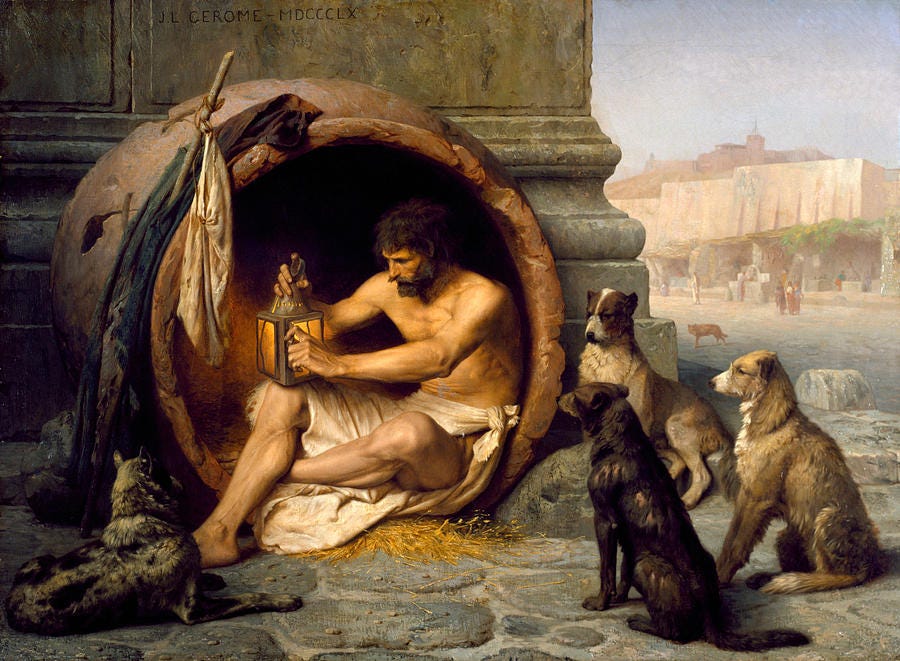
We like to imagine cynicism as a form of hard-edged intellectual clarity—an updated version of Diogenes’ lantern, held aloft in search of truth. But modern cynicism is something different: not a search for truth, but a search for confirmation. It is the impulse to find any shard of evidence—no matter how flimsy—that supports what we already believe. As this attitude ossifies, it splits the citizenry into rival factions, shirts and skins, each defined less by principle than by rejection of the other.
The danger lies here: the contemporary cynic is simultaneously the hardest person to persuade and the easiest person to manipulate. That contradiction is the essence of the paradox. When people decide that nearly everything is a lie, they become uniquely vulnerable to any figure—media, political, or otherwise—offering “the real story.” In such an environment, skepticism becomes a form of gullibility masquerading as sophistication.
Layer this atop our hyper-polarized culture, where people reflexively disbelieve their own side’s missteps yet eagerly swallow the most extravagant accusations about their opponents, and social trust evaporates. Both political camps suffer from this pathology, but one side’s leadership has made a particular art of weaponizing ambiguity, deploying half-truths, omissions, and semantic evasions to keep its coalition in a constant state of mobilized suspicion.
Meanwhile, beneath this haze of mistrust and performative cynicism, many Americans carry an authentic and reasonable anxiety about the nation’s trajectory. The popular narrative that “MAGA is dead” bears little resemblance to political reality; the movement remains cohesive on core issues. If anything, it is the Democratic Party that appears increasingly fractured—its aging leadership at odds with insurgent activists, and its fading liberal wing challenged by a rising, openly illiberal faction.
Meigs’s critique of Carlson is not merely about one media figure’s pivot toward conspiratorial thinking. It is a symptom of a broader civic ailment: a collapse of trust so deep it has produced a public simultaneously unpersuadable and manipulable, skeptical yet credulous, convinced that deception is everywhere and therefore unable to discern where genuine truth still resides.
Americans must confront the Cynic’s Paradox—rejecting both naïveté and reflexive disbelief—or we risk forfeiting what remains of our shared civic foundation. The alternative is a country in which “just asking questions” becomes not a prelude to inquiry, but a pretext for abandoning truth altogether.
Another paradox is reading a piece like this and only having a heart emoji. One can love the writing and the sense it makes and still hate the conclusion.
So my logical next thought is, I will need to continue to be a cynic not only to mainstream narratives but alternative ones as well. Well, the rabbit holes will not dig themselves, so...