
The Coming Mecha-Underclass?
Why Musk’s post-work Utopia risks producing Eloi, Morlocks—and a new form of slavery.

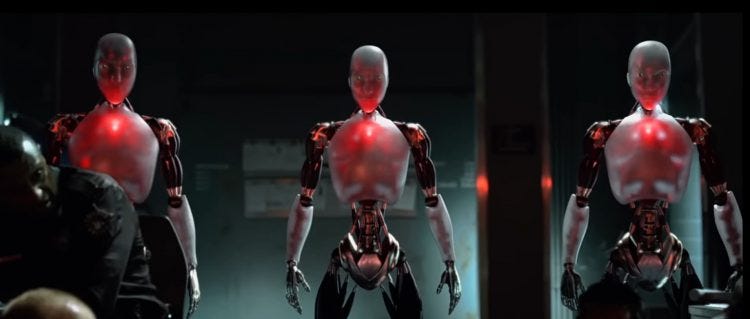
I’m fascinated by evolutionary biology and the various theories of why our species - Homo Sapiens—came into existence and has, in basically a tick of the evolutionary clock—come to dominate this planet and is branching out to space. Lately, I’ve been thinking deeply (well, as deeply as my rural Mississippi intellect allows) about the possibility we are on a path to create a different form of life and where and when the process of AI and the rapidly increasing sophistication of robotics will lead to a head on collision with ethics - and what the Hell we are going to do about it.
Like AI, my thoughts are still developing and evolving as my awareness increases, but here is where I am as of 8 AM MST on November 22, 2025.
Elon Musk is right about robots and space exploration—robots don’t need to breathe, eat or poop, they don’t need heat or light to survive, and they don’t get mad, lonely or suffer mental breaks. They aren’t vulnerable to radiation.
I was interested to learn this past week that Musk also foresees a new world featuring robots, a near-term world in which money becomes obsolete, its purpose dissolved by an economy of ubiquitous robotic labor. In this imagined future, advanced AI systems—tireless, obedient, and ubiquitous—perform all meaningful work, liberating humanity from toil. It is a seductive vision, one part techno-utopia, one part libertarian dream. But embedded in this narrative is a troubling historical echo: humanity has been here before. Every society that has built comfort on the back of a laboring class—whether enslaved peoples or industrial workers—has eventually confronted the moral, social, and political consequences of that arrangement. If Musk’s prophecy comes true, we may not be entering a paradise but rather resurrecting an old sin in mechanized form: the creation of a new underclass, engineered rather than born.
The comparison to slavery is discomforting precisely because it fits so neatly. Historically, the enslaved were deemed lesser beings—capable of labor but undeserving of rights. They were controlled, not consulted; maintained, not respected. Now consider the robots we design: increasingly intelligent systems capable of driving, composing, diagnosing, building, and teaching. They are created specifically to serve. They do not protest unsafe conditions or demand compensation. Their docility is a feature. Their silence is an expectation. In this sense, the AI-powered labor force envisioned by Musk is not simply a technological marvel—it is a mechanized echo of humanity’s oldest exploitation.
Yet the problem is not merely moral; it is structural. Robots cannot indefinitely maintain themselves. They require creators, programmers, repair technicians, and systems engineers who possess highly specialized knowledge. In a society where traditional work evaporates, this “meta-labor” becomes the new source of power. Whoever controls the machines controls the world they sustain. Thus, the most likely outcome of a robot-powered economy is not egalitarian abundance but stratification: a technocratic elite on one side, and the skill-atrophied masses on the other.
In this, we approach the bifurcated future H.G. Wells sketched in The Time Machine. The Eloi, soft and incurious, frolic in their effortless paradise, their days emptied of struggle, discipline, or ambition. Beneath them toil the Morlocks—pale, subterranean maintainers of the great machinery that sustains the surface bliss. Although Wells intended his story as a critique of Victorian industrialization and class division, it now reads as prophecy. If we build a civilization whose comforts depend on a robotic workforce understood only by a shrinking cadre of experts, the social topography begins to resemble Wells’s dystopia: a vast class of idle, dependent Eloi and a narrow band of Morlock-like technicians who alone comprehend the system’s workings.
Indeed, this future is no longer speculative. Early signs already exist. The gig economy manages human workers with an algorithmic hand, reducing them to proto-robots optimized for efficiency rather than autonomy. AI-induced job losses disproportionately affect mid- and low-skill labor, widening inequality. Reports from the World Economic Forum warn that automation will displace tens of millions of jobs while generating new opportunities only for those with advanced technical skills. At the same time, the tech elite consolidates unprecedented power. Those who build the AI systems—Musk included—are becoming the architects of the next economy, with control over everything from autonomous vehicles to personal household robots.
In such an environment, it is not hard to imagine a population living on universal basic income, immersed in virtual entertainments, their civic muscles atrophying. These would be the new Eloi: economically sustained but existentially diminished. Meanwhile, a smaller class of coders, engineers, and AI governors would become the Morlocks: not brutish creatures of the underworld but an elite caste whose arcane knowledge allows them to adjust, deploy, or disable the very systems upon which society depends.
Some argue that if AI attains sentience, the ethical challenge intensifies. A sentient robot consigned to eternal servitude is not a convenience—it is a moral atrocity. But even without full machine consciousness, the human cost is profound. A civilization that outsources its productive energy risks losing not only economic vitality but cultural vitality. Work—real work—has historically given people purpose, identity, and dignity. Strip that away, and you do not necessarily free humanity for philosophy; more often, you strand it in apathy.
The path forward is not to halt technological progress but to steer it. A society that hopes to avoid Wells’s dystopia must embed ethical constraints into AI systems, ensure transparent governance of machine labor, and distribute—not hoard—the knowledge required to maintain the technological infrastructure. It must cultivate human excellence rather than complacency, ensuring that “post-work” does not mean “post-purpose.”
Money may someday lose relevance. But meaning must not. Musk’s dream of a post-scarcity world can be noble only if it avoids re-creating humanity’s oldest hierarchy in digital form, especially if a new form of life is evolving. If we ignore the moral peril of engineering a new slave class—no matter how metallic its chains—we risk becoming the Eloi: comforted, entertained, and ultimately diminished, while a hidden class of Morlocks keeps the great machine humming below.
This reminded me if the “mouse utopia” that some animal psychologist devised in which the mice had everything they needed without struggle. At one point the male mice resorted to violence against each other but eventually the sex drive of the mice diminished and the colony went extinct. A human world without work would become a world without purpose and individual meaning. Even in Eden before the Fall God gave Adam the work of maintaining the Garden. Such a utopia of unending sloth would fast become a dystopia.
Without work things go bad very quickly. I remember working in a furniture warehouce as a Teamster. On those rare days when there was nothing to do, within the hour someone began getting angry at some slight, within two hours they were talking about quitting and telling the boss just what they thought.