
The Bots Are Back in Town
X’s new transparency tool reveals how foreign operatives pose as U.S. conservatives to fracture the right from within.

Remember 2016? We were young, the living was easy, and the harvests of the Macedonian Content Farmers were plentiful! It was a simpler political age, when the losing side could still blame its defeat on a few thousand dollars’ worth of Russian Facebook ads and a cottage industry of Macedonian teenagers churning out clickbait in Veles.
The Clinton campaign, having decided that Wisconsin and Michigan were optional, discovered—after the loss—that the true culprit was not strategic hubris but a handful of Balkan content farms. The evidence that these trolls moved a single vote was vanishingly small, yet the myth calcified: foreign meddlers had hijacked American democracy.
Nine years later, the trolls are back. Only this time, they’re not pretending to be disaffected left-wing activists. They are posing as something far more destabilizing: right-wing American patriots.
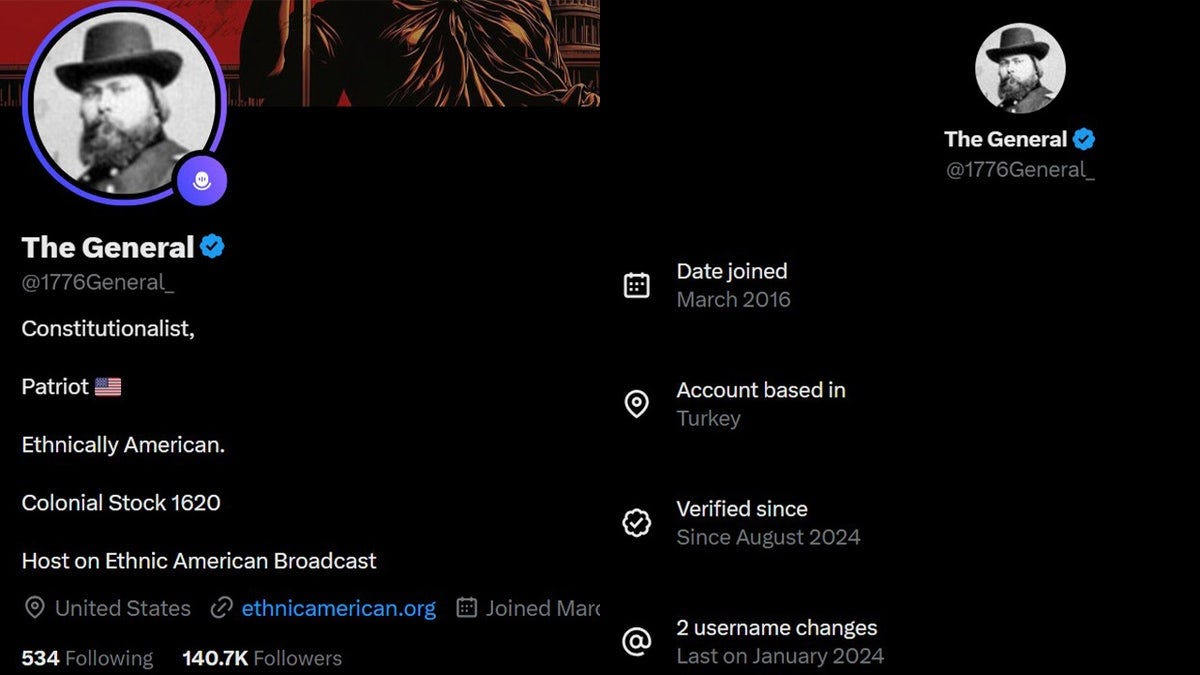
On an otherwise quiet Friday in November 2025, X rolled out a deceptively modest transparency feature. Tap the “Joined” date on almost any profile and a new panel reveals the country from which the account was originally created—via its first IP address, device metadata, and app-store region. In an instant, a diaspora of foreign actors masquerading as heartland conservatives was exposed.
Accounts that spent years thundering about “America First,” denouncing Trump as a traitor to Israel, or railing about “Zionist control” turned out to be operated from Karachi, Lagos, Dhaka, and Tirana. One supposedly salt-of-the-earth MAGA influencer—profile picture stolen from a Kansas real-estate agent—was posting daily from a suburb of Islamabad. Another self-styled “Christian nationalist” calling for civil war was, in fact, an interconnected cluster of Nigerian operators. A third account, famous for its viral threads accusing Israel of “genocide,” traced back to a single apartment block in Bangladesh.
The pattern was too consistent to dismiss as coincidence. These were not isolated pranksters. They were coordinated networks impersonating the American right with increasing sophistication. Their rhetoric borrowed the cadences of genuine populism—skepticism of NATO, suspicion of donors, frustration with foreign entanglements—but always nudged them into darker, more extreme territory: overt antisemitism, conspiratorial narratives, and a vision of “America First” that metastasizes into “America Alone.”
The goal was not persuasion but fissure. By posing as the dissident edge of the right, these impostor accounts sought to estrange mainstream conservatives from their traditional pro-Israel allies and to make the broader movement appear grotesque, unstable, and morally compromised. It was fracture-by-proxy, division through mimicry.
Ironically, progressives spent years insisting that the gravest threat to political discourse came from Russian bots boosting Trump. Now many of the most toxic voices inside the right-wing ecosystem turn out to be foreign operatives promoting narratives—anti-Israel, anti-interventionist, anti-Western—that large segments of the left quietly share. The Macedonian teenagers have been replaced by something far more professional and, judging from the immediate self-deletions of exposed accounts, far better resourced - and major news outlets are reposting material from these accounts without question. I guess the content is too good to check.
Yet the deeper vulnerability lies not with X but with us. A political movement that prides itself on skepticism of institutions is uniquely susceptible to impersonation. When your brand is distrust, the counterfeit dissenter blends seamlessly into the chorus. Layer on the algorithmic bias toward outrage, and a Pakistani operative tweeting grainy “war crimes” footage under the handle @RealPatriot1776 can harvest more engagement in a week than a thousand legitimate citizens can in a year.
Remember that I just wrote about the Cynic’s Paradox where I posited that cynics are the hardest to convince but also the easiest to manipulate.
If so much fake content could be produced by so many fake accounts so quickly, one might deduce that the rapidly rising support for people like Nick Fuentes and Andrew Tate might be little more than AstroTurf. Reports by “journalists” allegedly witnessing the “genocide” in Gaza turn out to be coming from Austria, Egypt and Pakistan.
This is not just a right-wing problem but an American one. The same platforms that once hosted Kremlin sock puppets posing as Black Lives Matter activists now host Third World operatives posing as heartland nationalists. The common denominator is not ideology—it is the weaponization of chaos. Division is the product; Americans are the market.
X’s transparency tool will not end the deception. VPNs exist, and motivated networks will adapt. But the feature has already accomplished something more valuable: it has exposed how much of our internal warfare is being scripted by people who have never set foot in the country they claim to speak for. The harvest is still plentiful—only now we can finally see whose hands are gripping the sickle.
Ultimately, the most powerful safeguard against foreign impostors is not new software but an old American habit: asking the stranger at the town meeting to stand up, state his name, and show his face. For the first time in years, the platform has allowed us to glimpse who is actually in the room. The picture may be ugly, but at least it is no longer blurred.
Thanks so much for telling me how to see it! I didn't know, and I'm going to like that feature.
Keep up the good work.