
The Assimilation Imperative
America can remain a nation of immigrants—but only if newcomers embrace the constitutional and cultural framework that makes American freedom possible.

The instance of massive fraud and its ties to the Somali migrant community in Minnesota has returned focus to the sieve of immigration once again.
I have stated I believe that fundamentalist Islam is not compatible with American republicanism but I also understand that the debate over immigration and religious pluralism often devolves into an unproductive exchange of absolutes. Recently, I have been giving due consideration to the idea that rather than asking whether particular cultures or faiths are inherently good or bad, we should focus on a more practical question: What does successful integration into American civic life require?
This question matters because America possesses a distinct constitutional and cultural inheritance. The Declaration of Independence, the Federalist Papers, and the Constitution establish not merely a system of government but a framework of principles from which our entire legal and civic order flows. Any serious discussion of immigration must grapple with how newcomers relate to this framework.
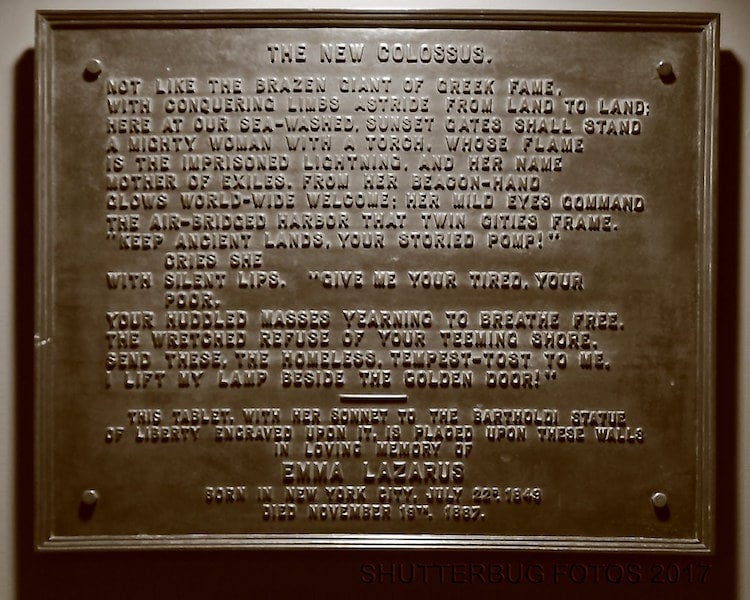
Emma Lazarus’s sonnet “The New Colossus,” affixed to the Statue of Liberty, offers insight into this relationship. Most Americans know only the famous lines: “Give me your tired, your poor, / Your huddled masses yearning to breathe free.” Yet the poem’s opening instruction—”Keep, ancient lands, your storied pomp!”—suggests a crucial condition. America welcomes those seeking freedom, but implicit in that welcome is the expectation that newcomers will embrace American principles rather than recreate the societies they left behind.
All of this means that choices must be made, and such a choice means there are some ideologies, theologies, cultures—and even attitudes toward assimilation—that will be judged insufficient and therefore to be excluded. There is no other conclusion other than that America’s doors will be—and must remain—closed to some. America cannot continue to import her enemies.
Some will undoubtably claim this is tantamount to xenophobia or racism when it has nothing to do with either, it is a matter of survival.
We might distinguish between two forms of diversity with profoundly different civic consequences. Constructive diversity brings together varied cultural experiences and approaches in pursuit of common goals. Immigrants retain meaningful connections to their heritage while fully participating in American civic life, learning English, and accepting the constitutional framework. Divisive diversity occurs when immigrant communities pursue separate agendas, maintaining primary allegiance to their countries of origin, rejecting integration into common institutions, and seeking to establish parallel legal or social systems incompatible with American constitutional principles. The former strengthens the nation; the latter fragments it.
America’s founding generation drew heavily on Judeo-Christian intellectual traditions. While the Constitution wisely establishes no official religion, the documents and debates of the founding era reveal deep engagement with Biblical concepts of human dignity, covenant, and limited government. This does not mean America belongs exclusively to Christians and Jews, or that citizens of other faiths cannot fully participate in American life. It means that when conflicts arise between particular religious practices and constitutional principles—freedom of speech, equality before the law, separation of church and state—the constitutional framework must prevail.
For most of American history, assimilation was understood as essential to successful immigration. Newcomers were expected to learn English, understand American history and government, and adopt civic norms. This did not require abandoning one’s faith or forgetting one’s heritage, but it did require accepting America’s constitutional order as supreme. Over recent decades, this expectation has weakened. Large urban enclaves now exist where English is rarely spoken, and American civic culture barely penetrates. In the name of multiculturalism, practices incompatible with American law have been tolerated.
The Immigration and Nationality Act of 1965 abolished national-origins quotas favoring European immigrants, replacing them with family reunification preferences. This triggered dramatic demographic shifts and coincided with the weakening of traditional assimilation expectations.
This trend cannot continue without consequences. As Lincoln warned in 1858, echoing Biblical wisdom, “A house divided against itself cannot stand.” A nation cannot long survive when significant populations reject its foundational principles or pursue competing visions of the social order upon which America is constructed.
The solution is not to close America’s doors to all, but to clarify what successful integration requires. Immigration policy should prioritize those genuinely seeking to become Americans, not merely to access economic opportunities while maintaining separate civic identities. Language acquisition should be expected and facilitated, as English fluency is essential for full civic participation and economic mobility. Religious freedom must be preserved, but religious practices cannot supersede constitutional law. Civic education should emphasize American history, constitutional principles, and shared civic obligations—not uniformity but unity, a common framework within which diversity can flourish.
America can remain a nation of immigrants while also remaining America.
This requires recovering the concept of assimilation—not as cultural erasure, but as civic integration. The question is not whether diversity is good, but what kind of diversity a constitutional republic can sustain. The answer lies in maintaining a strong civic core—a shared commitment to constitutional principles and democratic participation—while allowing cultural pluralism to flourish within that framework.
This is the balance America achieved for most of its history. Recovering it is essential to the nation’s future.
If Americans desire America to continue, the hard choices that have been delayed since views on immigration changed in 1965 must now be made.
Islam isn't truly a religion. Only 14% of the Koran's verses have anything remotely to do with the relationship of men and women to God, or "Allah" as they have named him. The rest of the Koran reads like a political and military strategy on how to deal with infidels, Christians, Jews and all other non-Muslims, which basically boils down to taxing, converting and ultimately murdering them should they not submit to Allah and Islam.
Islam is an ideology whose Sharia Law doctrines and Hadith demand it reign supreme over the entire world by way of infiltration and procreation and military and political conquest whenever and whenever possible. In as much as so many of its leaders are already on the record that Islam will reign supreme over America as soon as they can make it happen, it should be more than obvious that this is an ideology intent on the overthrow of the U.S. Republic, much in the very same manner as employed by Democrat Party Communists, and it must be treated as such by expelling all Muslims from America under the 1952 McCarran Act.
Islam represents the Mother of all Totalitarianisms: the Theocratic State -- the most harsh and cruelest of all ideologies known to mankind and a bane to man from its first days when it crawld from under a rock in the Saudi Arabian Peninsula to curse the world.
Islam is not a religion and its ideology cannot "coexist" within America's system, since Islam never does really desire to coexist with anyone, only to reign supreme.
Destroy America's mosques or repurpose them and eradicate every last vestige of Islam in America.
~ Justin O Smith
The president in 1965 was LBJ the father of, among other things, "The Great Society," Medicare and Medicade, immigration laws as mentioned here and federally insured student loans.