
Religious Debate on X
Not really the place to have such a debate, but I got sucked into one.

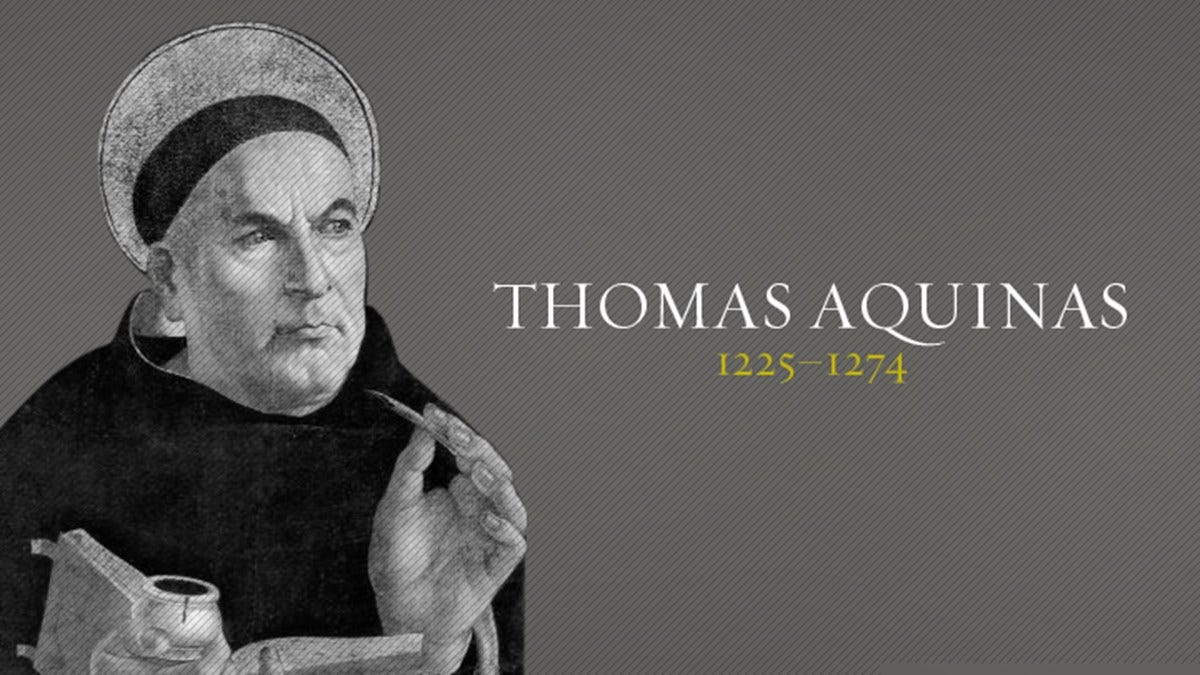
A few days ago, I published a post titled “The Order of Charity” based in a recitation of St. Thomas Aquinas’ ordo caritatis (order of charity) in his Summa Theologica, particularly in Secunda Secundae Partis, Question 26 where he argued that love should be ordered according to a hierarchy based on the closeness of the relationship and the nature of the good being sought.
It was in response to attacks on VP J.D. Vance when he mentioned such an order in an interview, and of course the religious scholars on X went nuts about it. In the context of illegal aliens, it seems if you don’t make your family destitute and give everything you have to illegal aliens then you are a sinner. I have been called everything you can think of on X, most of which is rooted in complete (and seemingly willful) misunderstanding of what JD said and meant and what I have been trying to show, that being there is certainly a biblical admonition to love everyone, but such a thing is a practical impossibility.
I was accused of not being a Christian because they say I am ignoring Jesus’ command to love all of our fellow men and women by people I suspect are raging hypocrites. One was an admitted atheist.
For the record, I’m not Catholic, I am Southern Baptist - but this is how I understand what Aquinas wrote back in the 1200’s, not because I revere a Catholic Saint, because it makes practical sense to me.
I just responded to such an accusation that I’m just a partisan who twists the Word of God to fit my political worldview by writing/tweeting:
Completely misstates the issue. Aquinas recognized the reality of our existence, you can say you love everyone and you should, but in practical terms there is a priority in how that love is expressed.
Everybody expressing shock at any "order of charity" is being a bit hypocritical - even if you claim to be following Jesus' command to love others as yourself, it is simply not possible you treat a completely unknown person half a world away the same way you treat your children or your parents. If you were placed in a situation where you had to choose between one or the other in a life or death situation, if you tell me you are going to choose some random person in a foreign country over your own child, I'm going to suggest you would be lying - unless I am the only one who would choose that way.
People may claim to "love mankind", and while that is possible at some level, the love for those closest to you is far more intense than even love for a friend or a co-worker.
It is also not mutually exclusive - just because I would die for my wife or any of my kids, doesn't mean I have no sympathy for someone in dire need whom I don't know.
What everybody is missing as they take shots at people like me is that theologians like Aquinas said that ALL love is to be given to God and the order of charity was a way to explain how humans should achieve that given the realities of human relationships and interactions.
I mentioned in other tweets that Aquinas' order of charity provides a structured, theological rationale for how love should be prioritized in Christian life and it is biblically based supported by reason and logic, that he based his ordo caritatis (order of charity) on several key theological, philosophical, and Scriptural foundations:
1. Sacred Scripture (Biblical Basis)
Aquinas drew extensively from Scripture to justify his hierarchy of love. Key passages include:
Matthew 22:37-39 – Jesus' command to love God above all and love one’s neighbor as oneself.
1 John 4:7-12 – The idea that love originates from God and should be extended to others.
Galatians 6:10 – "Let us do good to all men, especially to those who are of the household of faith," which Aquinas uses to argue for prioritizing fellow Christians.
1 Timothy 5:8 – "If anyone does not provide for his relatives, and especially for members of his household, he has denied the faith," supporting the priority of family love.
2. Aristotelian Philosophy (Natural Order and Justice)
Aquinas was heavily influenced by Aristotle’s concept of natural order and justice:
Aristotle’s Nicomachean Ethics (Book VIII) discusses different kinds of friendship and love, including familial and civic relationships.
The idea that justice requires giving priority to those to whom one has greater obligations (e.g., family over strangers).
The notion that love is naturally stronger toward those closer in relation, but should ultimately be ordered toward the highest good (God).
3. Augustinian Theology
Aquinas was influenced by St. Augustine, especially:
Augustine’s De Doctrina Christiana (Book I), where he argues that love should be directed toward God above all.
The City of God, where Augustine discusses ordered love (ordo amoris), stating that the right ordering of love is crucial to moral life.
4. Theological Reasoning (Nature of Love and Beatitude)
Aquinas defines love in relation to:
God as the Supreme Good – Since God is the highest good, all love must be ordered toward Him.
The Ultimate End (Beatitude) – Love should be directed toward achieving eternal happiness with God.
Grace and Supernatural Love – Aquinas distinguishes between natural affections and the supernatural virtue of charity (caritas), which aligns love with divine will.
Thus, Aquinas' ordo caritatis is a synthesis of Biblical teaching, Aristotelian philosophy, Augustinian thought, and Thomistic theological reasoning, all structured around the ultimate goal of directing love toward God as the supreme good.
I consistently admire your apparent willingness to engage with the uninformed and those not interested in truth and reason. I have not read all the authors you cite -- enough of them to have understood the importance of the principles to live a well-ordered life with deep love for my family. Thomas Aquinas is indeed a primer to understand all the others cited.
These critics who are so eager to leverage our religious convictions to serve their political ends are hypocrites because the only “god” whom they serve is their quest for partisan power.