
Relative vs Absolute
Our practice of politics has changed, and not for the better.

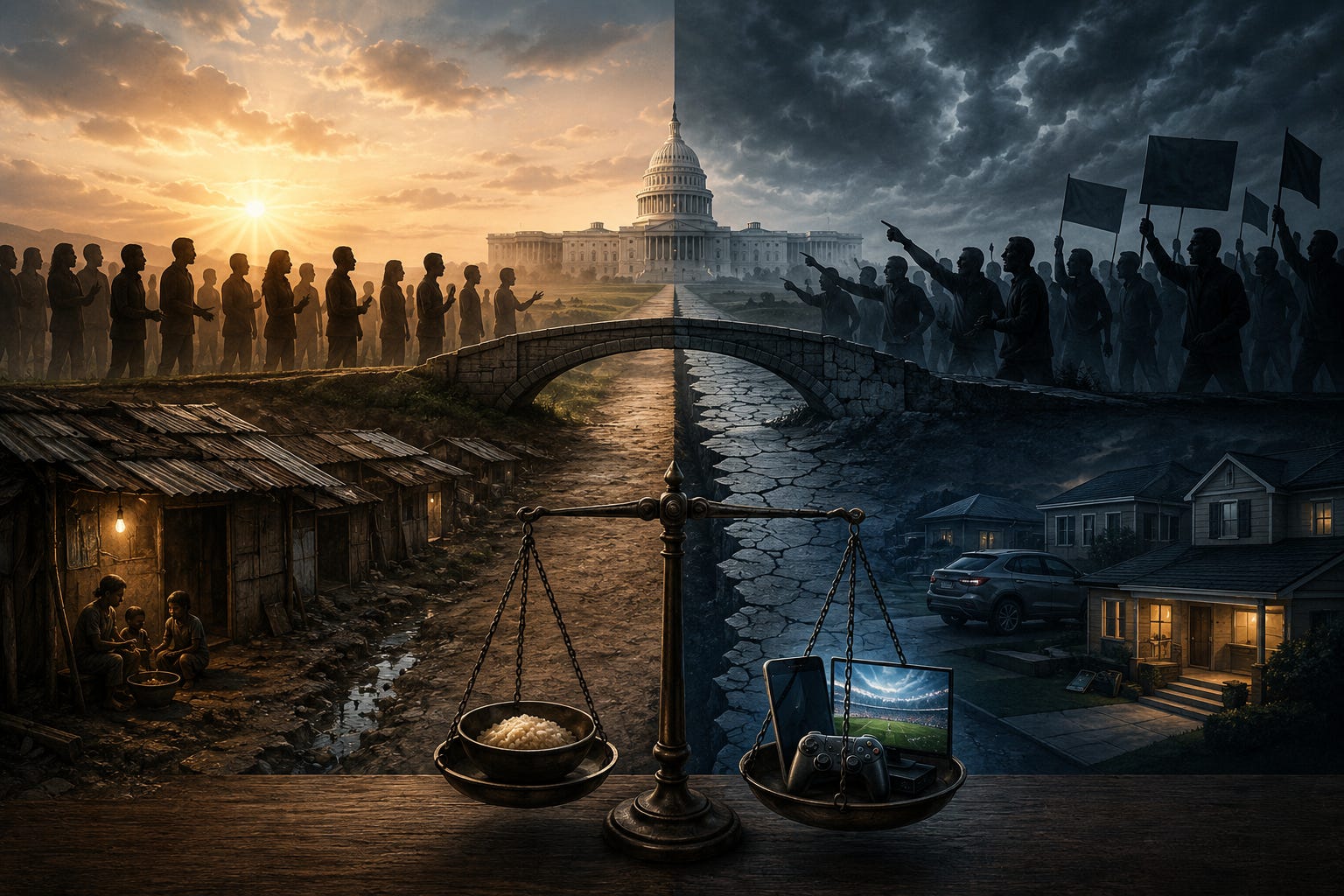
I’ve noted in the past that there are two kinds of poverty: absolute poverty and relative poverty.
Absolute poverty is a daily struggle for survival. I think of the slums of New Delhi or the outskirts of Bangkok, where families live in leaky one-room shacks beneath a single light bulb and survive on little more than a bowl of rice each day. The challenge is not comfort, convenience, or opportunity. The challenge is simply staying alive.
Relative poverty is something different. It is the standard primarily used in the United States, where poverty is measured as a percentage of median income. Under that definition, people who own televisions, automobiles, mobile phones, air conditioning, and gaming systems can still be classified as poor. Efforts to alleviate relative poverty are not really about assuring survival; they are attempts to guarantee a particular standard of living. The problem is that relative poverty is inherently difficult to eliminate because the benchmark moves. As incomes rise throughout society, the poverty threshold rises as well. The goalposts never stop moving, which means the finish line can never truly be crossed.
Recently, I found myself wondering whether the same distinction applies to politics.
There is absolute politics, and there is relative politics.
For much of modern American history, politics was largely absolute. The parties disagreed, often fiercely, but they generally operated from a common understanding of certain principles and goals. Both sides believed in the legitimacy of American institutions. Both sides largely accepted the constitutional framework. Both sides wanted prosperity, security, and opportunity, even if they disagreed about how best to achieve them. There were lines that could not be crossed and principles that could not be abandoned. Political combat was often intense, but it occurred within a shared civic framework.
That consensus began to weaken during the disputed election of 2000. The national unity that emerged after September 11 temporarily delayed the process, but as the wars in Afghanistan and Iraq dragged on and public confidence in institutions eroded, the old consensus continued to unravel. At first, the country drifted toward relative politics. Then it seemed to crash headlong into it.
Two recent examples brought this into focus for me: the reaction to preparations for America’s 250th birthday and the Maine Senate race.
Regarding America 250, I saw a social media post from a user called “Bookshelf Q. Battler” who observed that in another era Hollywood, television networks, and the broader entertainment industry would have enthusiastically embraced a milestone anniversary of the nation’s founding. Concerts, documentaries, historical dramas, and patriotic celebrations would likely have filled the airwaves. Instead, the enthusiasm seems muted because Donald Trump happens to occupy the White House. The implication was simple: if a successful national celebration might reflect positively on Trump, then the celebration itself becomes suspect.
The observation may be somewhat tongue-in-cheek, but it points toward a larger reality. Increasingly, the question is not whether something is good, beneficial, or worthy of support. The question is whether it helps or hurts the other side. If it helps the opposition, it must be opposed.
The Maine Senate race provides an even clearer illustration. Susan Collins has spent much of her career as exactly the kind of Republican Democrats routinely claim they wish more Republicans would be. She frequently works across party lines, cooperates with Democrats, and has often voted against her own party on significant issues. One might reasonably assume that such a figure would be viewed as preferable to a more traditionally conservative Republican.
Yet opposition to Collins remains intense. The objective is no longer simply advancing policy goals. The objective is maximizing political distance from anyone carrying the Republican label, regardless of how closely that individual may align with Democratic positions on particular issues. In relative politics, the spread itself becomes the point.
That is the defining characteristic of political relativism.
In many respects, today’s Republican Party is more progressive than it was thirty years ago. Donald Trump himself has frequently embraced positions that would have been considered populist or even moderately progressive in earlier political eras. Yet rather than narrowing political differences, the opposing side often responds by moving further away. The goal is not agreement. The goal is separation.
The politics of relativism means the goalposts never stop moving. Positions change, principles become negotiable, and today’s certainty becomes tomorrow’s heresy. Political identity ceases to be rooted in enduring beliefs and becomes instead a reaction to whatever the opposition happens to support. The overriding objective is maintaining distance, even if doing so requires embracing positions that would have seemed absurd only a few years earlier.
Like relative poverty, relative politics offers no natural endpoint. It cannot be solved through negotiation, compromise, spending, or persuasion because the issue is not the substance of the positions themselves. The issue is preserving the gap between them.
A constitutional republic functions best when politics is anchored to something fixed and enduring. It works when citizens and parties share at least some common principles, common institutions, and common understandings about the nation’s future. In other words, it works when politics is absolute rather than relative.
Without that anchor, the goalposts continue to move, the distance continues to widen, and politics becomes less about governing and more about ensuring that no bridge can ever be built.
Well a lot of this partisan hostility is also due to the left’s embracing oikophobia - the hatred of one’s own nation and culture.
Groucho said it best…” I have principles. And if you don’t like them I have others”