
Reading vs Visual Culture
A decline in reading is a civilizational lament.

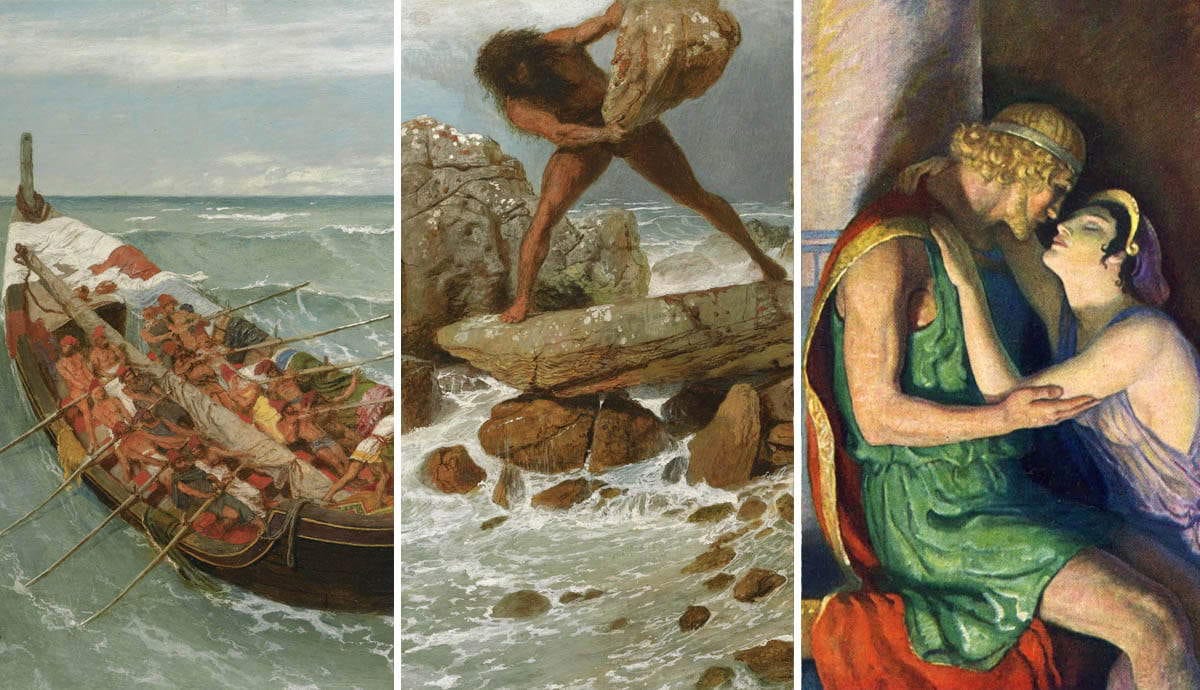
I was thinking about this in conjunction with the race and gender swapping of characters in movies and plays, the controversy surrounding the casting of certain characters in Christopher Nolan’s version of The Odyssey, scheduled to be released this week, and the essay I wrote last week about how reading a book is becoming more of a rare occurrence these days.
I just finished an interesting book by a favorite author of mine, and I was thinking how mentally engaged I get when I read a book that interests me as contrasted to the passive nature of watching a movie in a theater or from a streaming source. It occurred to me that one of the quiet tragedies of our increasingly online and visually oriented culture is that we are slowly losing one of the greatest gifts reading has to offer: the opportunity to create an entire world inside our own minds.
That may sound like nostalgia talking, but I don’t think it is. It is one of the reasons great literature has survived for centuries while countless spectacular films are forgotten within a few years. Reading is not simply entertainment, it is a full- contact participation sport because when we watch a movie, virtually every creative decision has already been made for us. The casting director chooses the faces. The costume designer chooses the clothing. The cinematographer decides what the landscape looks like. The composer tells us when to laugh, cry, or feel suspense and as a product of this process, we are presented with a finished product, polished and complete, requiring relatively little from us beyond attention.
I’ve always appreciated how a book works very differently.
The author gives us the framework—a plot, dialogue, personalities, motivations, and enough description to guide us—but then quietly hands the rest of the responsibility to the reader. Every page asks us to become the casting director, production designer, cinematographer, and even the special effects department. The story unfolds not on a screen, but inside our own imagination. You fill in the blanks and begin to “see” it in your mind rather than on a massive IMAX screen.
It could be argued that such a collaboration between author and reader is one of humanity’s most remarkable creative acts.
It also explains why readers so often leave a movie theater saying, “The book was better” or “That isn’t how I visualized that character.” They usually aren’t complaining that the actors were poor or the special effects weren’t convincing, they are lamenting the loss of their version of the story. For days, weeks, or even months, they lived with characters whose faces existed only in their own minds. Then, in two hours, Hollywood replaced those deeply personal creations with someone else’s interpretation.
There is another fascinating aspect of literature that rarely receives the attention it deserves. Unless an author intentionally makes a character’s physical appearance central to the story, readers naturally fill in those details from their own experiences. They imagine voices they’ve heard, faces they’ve known, expressions they’ve witnessed, and personalities they’ve encountered throughout their lives. Every reader creates a slightly different world, and none of those worlds is necessarily wrong because each exists within the boundaries the author intentionally left open.
In that sense, literature is perhaps the most inclusive form of storytelling ever invented and we are losing it as we argue over racial and ethnic quotas in movies. In many cultures of history it was a crime to teach the lower classes and slaves to read because that might encourage them to think for themselves.
Literature is the liberation of the mind because it doesn’t demand that every reader see the same face or picture the same street. It allows millions of people to inhabit the same story while experiencing it in uniquely personal ways.
I sometimes wonder whether this is one reason our culture seems to struggle more with imagination than previous generations did. We have become accustomed to consuming finished images rather than constructing our own. Instead of exercising the mental muscles required to build worlds from words, we increasingly wait for someone else to show us what those worlds should look like.
Reading demands effort. It requires vocabulary, concentration, memory, and imagination. Yet those demands are precisely what make it valuable. Every novel asks us to think, infer, empathize, and create. It transforms us from spectators into participants.
Perhaps that is why the greatest books never truly belong to their authors after they are published. They belong to every reader who opens them. Each person reads the same words but experiences a different story, populated by different faces and landscapes, shaped by different memories and emotions.
No movie, regardless of its budget or technical brilliance, can ever accomplish that.
The greatest theater in the world has never been built of brick and steel. It exists between our ears, illuminated by nothing more than ink on paper and the boundless capacity of the human imagination.
And those electronic reading tablets don’t help because while they show the text of a book electronically they also seem to be riddled with hyperlinks for every name or key word such that the reader becomes more easily sidetracked by scrolling through the links which fragments the attention you would otherwise have given without interruption to the text.
Excellent essay. Thank you!