
Profiles in Timidity
The RINO revival is not a movement—it’s a retreat, carefully choreographed for polite applause.

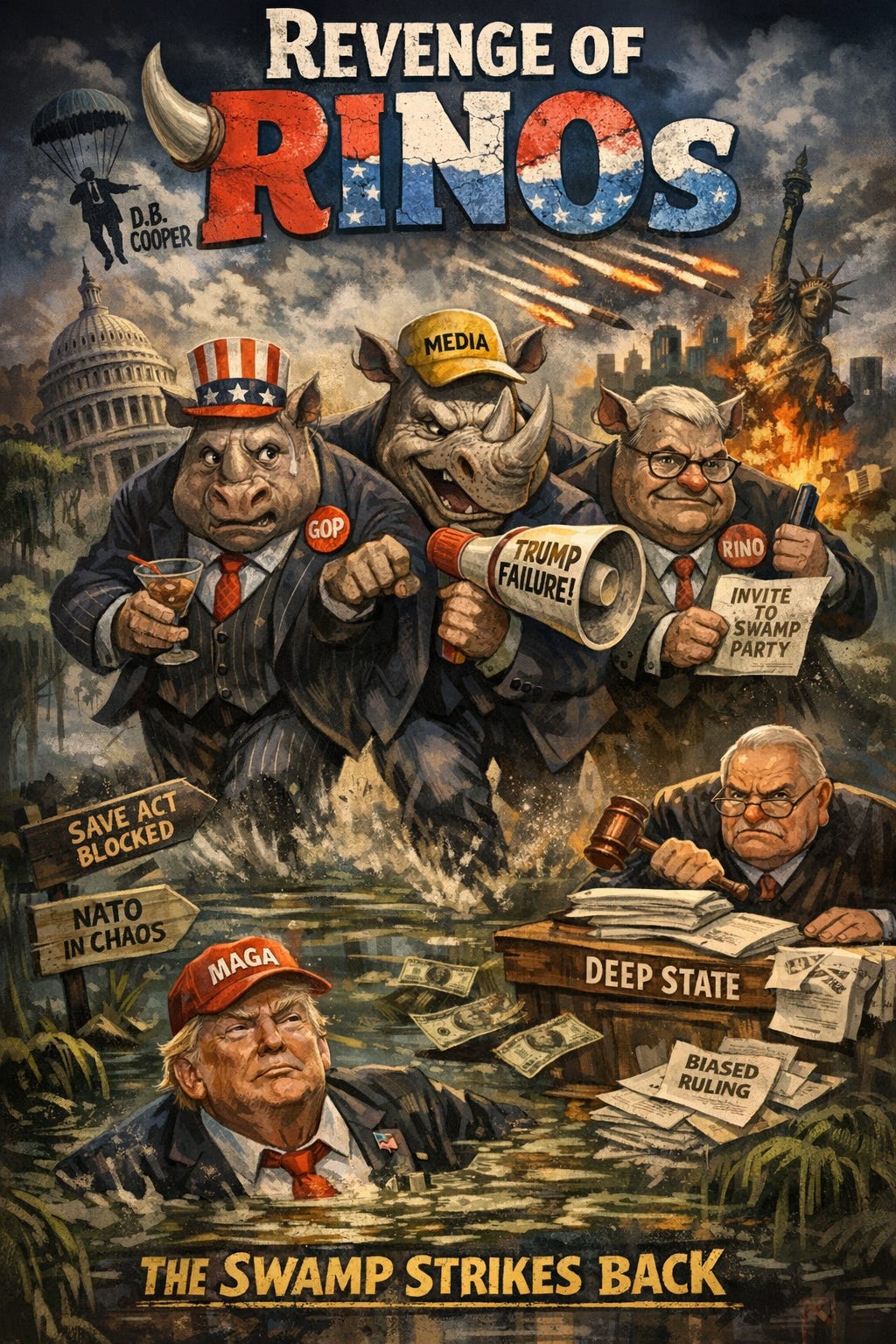
If you feel even a faint unease about the current state of politics and media, take comfort: you are not suffering alone. You are simply paying attention.
The recent heel-turns from figures once thought to be allies—Carlson, Owens, Kelly, Joe Kent—have the distinct odor of opportunism. The shift seemed to begin in earnest after Charlie Kirk’s assassination, though at the time it registered more as background noise than a pattern. Only recently has the pattern revealed itself. Rand Paul’s peculiar fixation on Mullin, delivered with the self-satisfaction of a man auditioning for his own legend, combined with Kent’s theatrical resignation letter—complete with accusations against Trump and Israel—clarified matters. These were not serious interventions. They were performances. And not particularly convincing ones.
Manual labor has a way of stripping away illusion. While moving seven cubic yards of mulch—one wheelbarrow at a time, under the general direction of my wife—I had ample opportunity to consider the spectacle. Physical exhaustion tends to sharpen rather than dull certain kinds of thinking. By the time the last load was dumped, the conclusion seemed unavoidable:
The RINOs are preparing to stampede.
The timing is not accidental. Consider Senate Majority Leader John Thune, who manages the curious feat of both delaying a bill with overwhelming public support—the SAVE Act—and lamenting procedural changes that would allegedly make the Senate less efficient. This would be amusing if it were not so transparent. The Senate abandoned any pretense of being the “great deliberative body” years ago. The filibuster, once a theatrical endurance test, has been reduced to clerical sabotage. What was once a formal banquet is now a takeout order—quick, disposable, and rarely satisfying. Legislation no longer dies in debate; it vanishes, like D.B. Cooper out the back of a Boeing 727 over Southwest Washington state, never to be seen again.
The Republican Party, we are often told, is full of fighters. This is true, provided one defines “fight” as an elaborate pillow exchange conducted at low velocity.
What we are witnessing now is not courage but calculation. The permanent political class—the swamp, if one prefers blunt language—has begun to contemplate the possibility that MAGA may not survive its founder. In anticipation, its lesser courtiers are repositioning themselves for relevance. Their aim is not victory, but acceptability. They seek to become once again the agreeable losers of Washington: reliable, malleable, and always available for polite applause from their supposed adversaries.
Their calculation is simple. If Trump falters, they can say, with great solemnity, “We warned him.” If he succeeds, they can quietly claim proximity. It is a strategy designed not for leadership, but for survival.
Naturally, they are not acting alone. The media, whose capacity for selective blindness remains one of the great modern marvels, has been an eager accomplice. Trump’s successes are not debated so much as ignored—a tactic more efficient than opposition. When acknowledgment does occur, it is often dressed in absurdity. One recalls The Atlantic solemnly declaring that the Iran conflict was “dragging on” by Day 13—a statement so detached from reality it borders on parody. By that point, Iran’s response had already devolved into sporadic gestures of defiance, while the anticipated chorus of escalation—from Russia, China, Hezbollah, Hamas, and the Houthis—failed to materialize.
This absence is instructive, though not, apparently, to those tasked with noticing such things.
The truth is less dramatic and therefore less useful to the narrative: the war threatens to be “forever” not because it is endless, but because it is uneventful.
Meanwhile, Trump receives little credit for reshaping trade relationships, exposing NATO’s dependency on American power, or revealing the hollowness of European leadership. Nor is there much enthusiasm for acknowledging that alliances with China and Russia have proven about as sturdy as paper umbrellas in a thunderstorm.
Faced with these realities, the RINO class has settled on its only viable strategy: manufacture failure. If success cannot be denied, it can be obstructed. If it cannot be obstructed, it can be misrepresented. And if all else fails, it can be blamed on the man who achieved it. This explains the curious tolerance for rogue judicial activism—Judge Boasberg’s rulings, for instance, proceed with all the resistance of a welcome mat.
The objective is not governance. It is narrative control.
And so the RINOs grow restless. They sense opportunity in the approaching midterms, and they intend to exploit it—not to defeat their opposition, but to reclaim their position as its most reliable auxiliaries.
They will speak in grave tones. They will invoke prudence, stability, and experience. They will warn of excess, even as they practice irrelevance.
And they will hope—fervently—that the public’s memory is as short as their own record is long.
It would be a mistake to oblige them.
I'm always amused how die-hard, life-long Republicans are dismissed as RINOs, while certain recent converts (*ahem* he was a registered Democrat in the 90s *ahem*) are the "true Republicans". Republicans retreat because they like being in office and out of power.
This isn’t a revival—it’s a surrender tour. The RINO class sees which way the wind is blowing and is hedging like their careers depend on it—because they do. When Donald Trump delivers results—on NATO, trade, and now war—they don’t lead, they reposition. These aren’t profiles in courage. They’re profiles in survival. Say just enough to distance, never enough to risk relevance. And the media plays along, laundering weakness as “principle.” It’s a familiar scam. But voters aren’t as dumb as Washington hopes. The base sees it clearly: when the stakes rise, the pretenders fold—and the real fighters keep moving forward.