

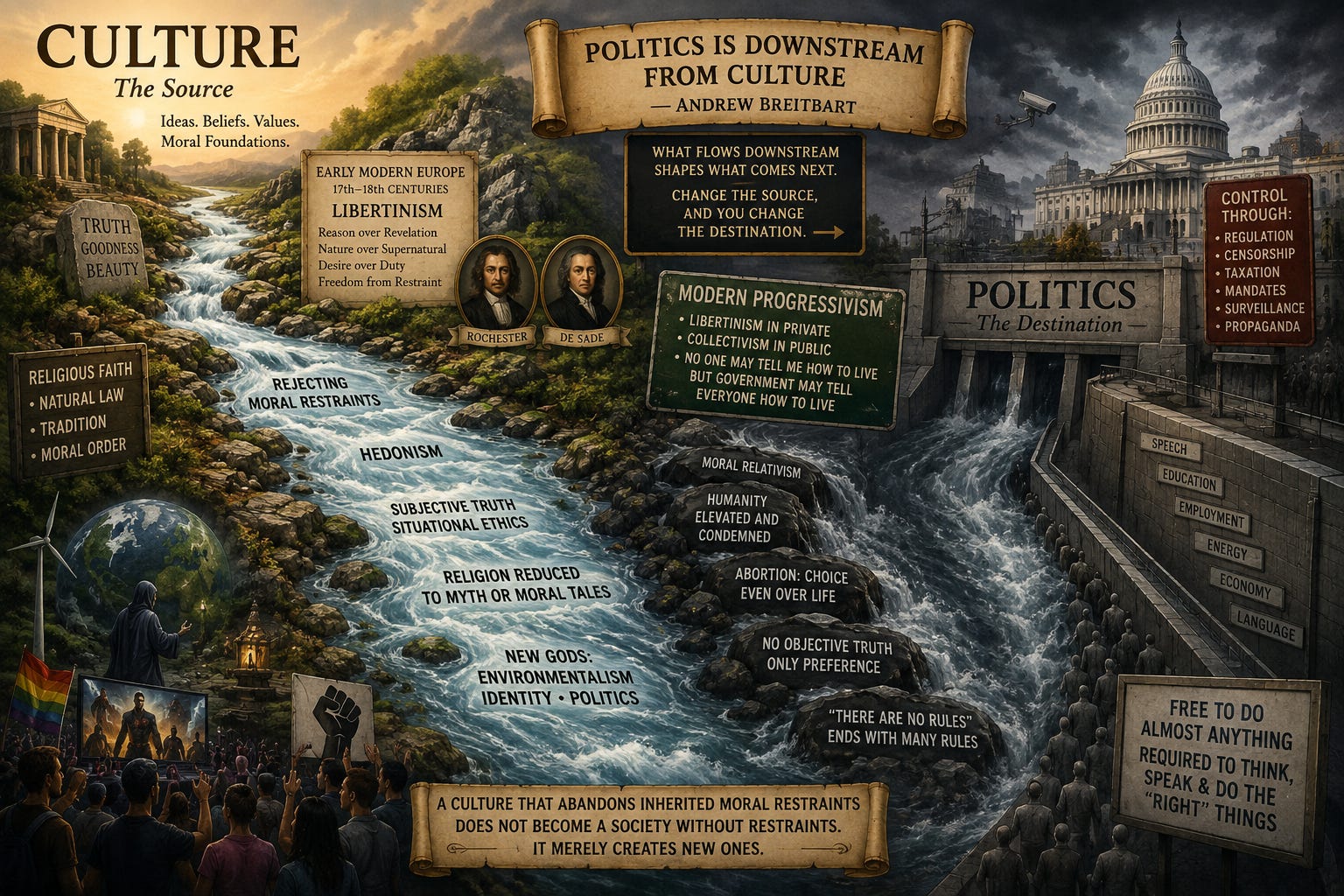
Andrew Breitbart famously said that politics is downstream from culture. If that is true, the more interesting question is not what is happening to American politics, it is what is happening to American culture that produces the politics we see.
For all the talk about revolutionary social change, much of what we are watching is not revolutionary at all. We have seen versions of it before.
Beginning in early modern Europe and becoming more visible in the seventeenth and eighteenth centuries, a philosophical current emerged that came to be known as libertinism. Its adherents challenged religious authority, traditional morality and inherited social conventions, elevating human reason, nature and individual desire over supposedly transcendent sources of truth. The term eventually became associated with figures ranging from the Earl of Rochester to the Marquis de Sade, although libertinism encompassed considerably more than sexual excess.
A libertine is commonly understood as someone who rejects conventional moral restraints, particularly those regarded as artificial impositions of religion or society. Taken far enough, libertinism becomes a form of hedonism. Sensual pleasure and personal autonomy become primary goods, while religious prohibitions and inherited moral codes become obstacles to be overcome.
Look around contemporary America and it is difficult not to see an echo of it.
We increasingly argue that sex can be separated from biology, morality from religious authority, ethics from permanent standards and human behavior from any larger purpose beyond individual preference. Traditional religious claims are treated skeptically while situational ethics and moral pluralism flourish. The Bible is increasingly regarded not as revelation but as literature, mythology or an occasionally useful collection of moral stories. Providence, miracles, divine judgment, heaven and hell have steadily disappeared from the moral vocabulary of much of the culture.
The result is not necessarily atheism or an abandonment of God, something stranger has happened. Traditional religion has often been replaced by either secular substitutes or a comic book version religion that features pop culture elements. For example, environmentalism has acquired the characteristics of a religion, complete with original sin, apocalypse, penance and redemption. Politics itself becomes theological and identity supplies something resembling a doctrine of the soul.
The old gods disappear, but humanity proves remarkably capable of creating new ones.
This is where modern progressivism becomes particularly interesting. It contains elements of libertinism while simultaneously demanding an extraordinary degree of political control.
Consider the strange combination. On sex, identity and personal morality, individuals are increasingly expected to be free of traditional restraints: biology yields to identity, sexual conduct becomes a matter of consent and choice, religious objections are dismissed as antiquated, and moral judgments are recast as intolerance.
Yet the same political culture that insists upon nearly unlimited autonomy in personal matters can demand increasingly strict regulation of economic life, energy consumption, speech, employment, education and even the language people use to describe reality.
The contradiction at the center of the modern progressive project is this idea: No one may tell me how to live, but government may tell everyone how to live.
Nowhere is the conflict more obvious than in the intersection of environmentalism, abortion and traditional morality. Humanity is simultaneously elevated and condemned. Man is supposedly liberated from divine authority and empowered to determine his own identity and moral rules, yet humanity itself is frequently portrayed as a planetary menace whose consumption, reproduction and economic activity must be constrained for the sake of nature.
We are masters of our own existence until we want to turn on the air conditioner or buy new tires in California.
Abortion presents an even sharper moral collision. Much of modern progressivism places extraordinary emphasis on protecting vulnerable life in some circumstances while defending abortion rights as a fundamental expression of bodily autonomy. Whatever one’s position on abortion, the philosophical tension is difficult to avoid: the same culture that increasingly describes moral restraints as illegitimate nevertheless makes enormously consequential moral distinctions about when human life acquires claims against individual autonomy. The individual is said to possess almost unlimited authority over himself, yet that autonomy can extend to deciding whether another developing human life continues at all.
From the traditional Christian perspective, this represents something far larger than a disagreement about public policy. It is the transfer of ultimate moral authority from God to man.
That brings us back to libertinism.
Modern progressivism sometimes appears to combine two impulses that should be incompatible: libertinism in private morality and collectivism in public life.
One says that the individual should be liberated from inherited restraints. The other says the individual must submit to an increasingly elaborate political program designed to produce approved social outcomes. In essence, free to do almost anything yet increasingly required to think, speak and do the “right” things.
Perhaps this is not as contradictory as it initially appears or maybe it is just purely predictable based on human behavior. Once an objective moral order is discarded, somebody still must determine the rules by which society operates. If those rules do not come from God, natural law, tradition or some other authority outside politics, they will inevitably come from human beings.
Historically, when possessing political power, humans have never demonstrated much reluctance to use it.
The great irony is that libertinism historically appealed to reason and nature against religious authority. Yet much of its modern cultural descendant seems increasingly uncomfortable with both. Nature becomes negotiable when biological reality conflicts with identity. Reason becomes suspect when logical conclusions conflict with desired social outcomes. Objective standards are replaced by subjective experience, yet those subjective conclusions are then enforced as though they were objective truths.
The idea that “There are no rules” always ends with an astonishing number of rules.
That may explain something about the peculiar political moment we inhabit. A culture cannot remain permanently libertine because civilization itself requires boundaries. People must eventually agree upon what may and may not be done. The only question is where those boundaries come from and who has the authority to enforce them.
A society that abandons inherited moral restraints does not become a society without restraints. It merely creates new restraints.
Our politics increasingly resembles a contradiction because the culture feeding it has become contradictory. We demand radical individual autonomy while constructing increasingly elaborate systems of collective control. Old moral absolutes rejected as new ones are invented and religious dogma is rejected while we manufacture political dogmas of our own.
If American culture seems confused, perhaps the best explanation is that it is.
A society built on lies cannot command trust. That is the crisis. Institutions still want the authority of churches, courts, fathers, schools, and constitutional government, but they have rejected the moral foundations that made that authority legitimate. They demand compliance while teaching that everything is constructed, oppressive, subjective, and disposable. No human relationship survives without trust. Neither does a civilization. Smith’s river metaphor lands because the poison was released upstream decades ago. The delta is now full of it: libertinism, collectivism, abortion worship, gender fantasy, climate religion, speech control, and institutional collapse.
In Exodus 32 Moses goes up on the mountain to receive the tablets of stone from God. God is clearly communicating His moral authority to a people he just rescued from slavery. As soon as Moses is out of sight, they, as a whole, decide it's a good idea to go back to the old gods who seemed to be more fun. They melt enough gold to create a golden calf that represents the "fun" gods and no moral restraint. God informs Moses of what just happened.
7 And the LORD said to Moses, “Go down, for your people, whom you brought up out of the land of Egypt, have corrupted themselves. 8 They have turned aside quickly out of the way that I commanded them. They have made for themselves a golden calf and have worshiped it and sacrificed to it and said, ‘These are your gods, O Israel, who brought you up out of the land of Egypt!’ ” Ex 32:7–8. ESV
It took about five minutes for the people to turn from God, who had just demonstrated His awesome power to them by delivering them from Egypt.
They knew better, but it's more fun to be your own little god and throw off all the silly constraints imposed by a limiting deity.
And so it is in our postmodern age. The idols of the heart (golden calves) are many, but they all add up to men and women wanting to be god.
One of the great ironies of our day is the libertine alliance with Islam and Marxism, two systems that control all aspects of life.