
Is America Good?
It is a valid question - but the answer, as always, depends on the definition.

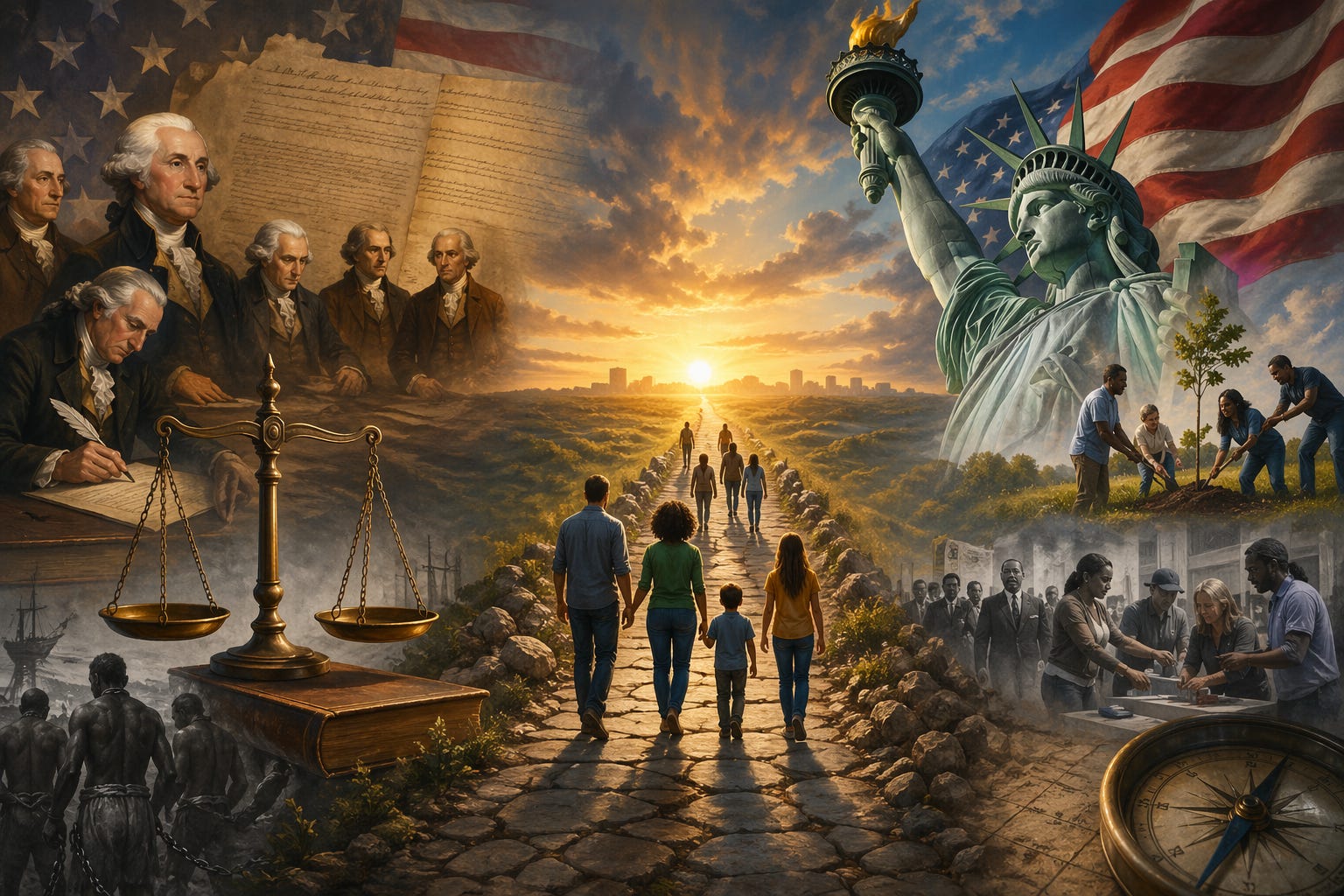
Thinking about the idea of “good,” especially when set against the long, unrelenting march of history, leads to a conclusion that is both simple and uncomfortable: “being good” is not a fixed condition. It is a process. It is continual effort, continual correction, and continual striving. Not a box to be checked, but a direction to be pursued.
That raises the natural question: is America “good”?
When I hear that question, I think of C.S. Lewis’s observation that no man truly knows how bad he is until he has tried very hard to be good. That insight cuts straight through the noise. Goodness is not something one declares and then possesses. It is something one attempts, often imperfectly and often unsuccessfully, over and over again. History is filled with nations and regimes that confidently proclaimed their own virtue, only to be judged later as anything but. Some of that reassessment reflects presentism, judging the past by modern standards, but not all of it. Some reflect enduring, transcendent principles that do not bend with time or fashion.
With that in mind, the American founding is worth considering not as a static achievement, but as a framework built on two distinct yet unified philosophical foundations.
The first is the legal philosophy embodied in the Constitution. It is the law of the land, written in clear language that defines the structure of the national government, enumerates its powers, and just as importantly, delineates what it cannot do. Those limits, reserving authority to the states and to the people, were not accidental. They were central to the design. Modern political movements have often treated those limits as inconveniences to be worked around or reinterpreted, but the original intent remains unmistakable. The Constitution is not merely a grant of power. It is a restraint upon it.
The second, and far less discussed, is the aspirational philosophy embedded in the founding era. It is not confined to legal clauses or procedural rules. It is found in the broader vision of what the country was meant to become. The Founders understood they were building a nation out of imperfect people, and that any system constructed by such people would itself be imperfect. They were not naïve about human nature. They did not assume that virtue would become universal simply because a new government had been formed.
Instead, they established guiding ideals and left space for future generations to wrestle with them. They did not resolve every moral contradiction — most notably slavery — not because they were unaware of it, but because resolving it at that moment would likely have prevented the union from forming at all. Faced with that reality, they chose to create a framework and embed within it principles that pointed beyond their own time. They set a direction rather than declaring a final destination.
Equally important, they resisted empowering government to solve every moral failing. They understood something often forgotten today: government intervention rarely fixes one problem without creating another. Laws can compel behavior, but they cannot transform character. Cultural change — the kind that reshapes societies over generations — comes from individuals persuading, influencing, and ultimately changing one another.
So, did America live up to its founding ideals at the moment of its birth? Clearly not. The contradiction between stated principles and lived reality was obvious even then. The more relevant question is whether those ideals have been abandoned or pursued.
The answer, imperfect as it is, is that the country has continued to try. Progress has not been linear. There have been advances, setbacks, and moments of profound failure. Yet the essential feature of the American system is that it allows for correction. It allows for continued striving toward those original principles. The nation does not always succeed, but it is not locked into its failures. It keeps stepping back to the plate.
That is what makes Calvin Coolidge’s understated remark so powerful. To live under the American Constitution, he said, is the greatest political privilege ever accorded to the human race. The privilege is not that the system is perfect, but that it provides the freedom to pursue something better.
This brings us to the question of myth, often deployed as a critique of the American story. Every civilization, every religion, every enduring movement carries stories that are simplified or symbolically powerful in ways that transcend strict historical accuracy. What matters more than their literal truth is how they are used.
Destructive or oppressive societies construct myths that justify their actions, excuse their past, and grant themselves permission for future abuses that are enforced through censorship, coercion, and force. Tools of control. Healthier societies cultivate what might be called an aspirational history. They emphasize ideals, highlight moments of courage and principle, and present a vision of what they believe they should become. Their darker chapters are not erased. They are simply not allowed to define the entirety of the national identity. The focus remains on the ideals that pull the society forward.
One form of mythology seeks to preserve power. The other seeks to preserve principles.
In the end, the question of whether America is “good” cannot be answered in the past tense. It is not a verdict to be rendered once and for all. It is a question that must be answered continuously—through actions, choices, and the willingness to measure reality against aspiration. The country’s value lies not in a claim of perfection, but in its persistent effort to close the gap between what it is and what it was meant to be.
Two points today.
1. Christian worldview is not about being made perfect by a confession of faith. It is about putting faith in an ability to continually strive toward the better by God's grace. Never arriving but always evaluating and adjusting one's life
2. Stephen Covey, in his 7 Habits book, pointed out an Abundance Principal. That we do not work in a zero sum world. Our Creator continues to give us ability to work and create.
We don't have to have a win-lose, give-take, profit-loss worldview.
I can't say whether we are good or not. But judging by the amount of people that want to come here, we must be better.