
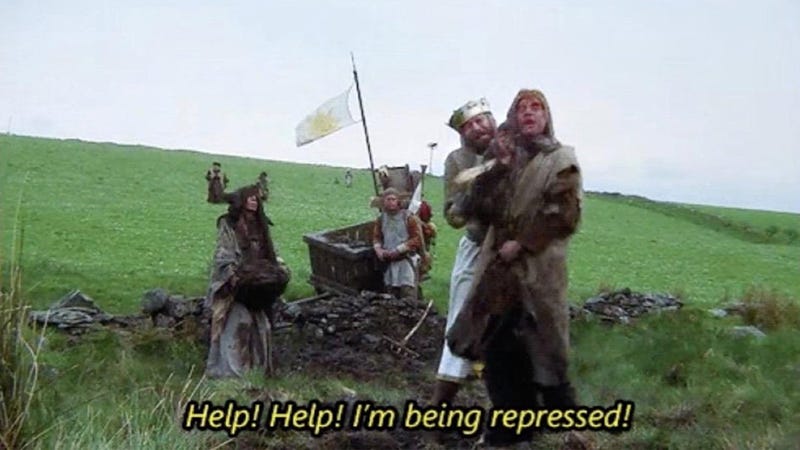
Help! Help! I'm Being Repressed! Come See the Repression Inherent in the System!
As usual, the future was foretold in a Monty Python skit - this one featuring King Arthur and Dennis the Peasant.

Yesterday, I noted that while the chosen heroes of the right are objectively good people, like Charlie Kirk, whom the left claim are bad people, the chosen heroes of the left are objectively bad people, like George Floyd, whom the left claim are good people. I did so because this is the process underpinning everything the left leverages to gain power – and it is the most dishonest, abused, illegitimate – and effective – dialectic in history: the oppressed/oppressor dialectic.
It explains why, regardless of reality, the left aligns with criminals (including murderers), illegal aliens, terrorists (Hamas, Hezbollah, and Iran), radical Islamists, drug smugglers, BLM, ANTIFA – aka the “oppressed.”
One might ask why they would do something so heinous.
Because it works - or at least it works enough to give them power (or in the case of the UK, a false sense of safety that they will be eaten last).
Rooted in Marxist and critical theory frameworks, it posits that society is fundamentally structured around power dynamics where one group systematically dominates another. While this lens has been used to analyze historical injustices, applying it as a universal explanation for social dynamics in 2025 America oversimplifies complex realities, understates the unprecedented social and economic mobility in our nation, and distorts the current reality.
The fact is the oppressor/oppressed dialectic is a false premise in contemporary Western Civilization and especially in America. Due to the America’s evolving social, economic, and political landscape the oversimplification of individual agency and the dialectic’s failure to account for multidimensional identities and systemic progress renders it moot.
The oppressor/oppressed framework assumes rigid, binary categories that no longer align with America’s complex social fabric in 2025. Historically, the dialectic was applied to clear-cut cases of systemic oppression, such as slavery or Jim Crow laws. However, today’s America is characterized by significant progress in civil rights, economic mobility, and legal protections. Legal barriers to equality, such as discriminatory voting laws or segregation, have been dismantled, and affirmative action policies, diversity initiatives, and anti-discrimination laws have reshaped institutions and framing all inequalities as the result of deliberate oppression ignores the role of class, geography, and individual choices. The dialectic’s insistence on a zero-sum power struggle fails to capture these nuances, reducing multifaceted issues to a simplistic – and often false – either/or narrative.
Next, the oppressor/oppressed model undermines individual agency by casting people as either perpetual victims or villains. In 2025, Americans have unprecedented access to tools for self-empowerment, including education, technology, and entrepreneurship. The rise of remote work, online learning platforms, and decentralized finance has democratized opportunities, allowing individuals to transcend traditional barriers. For instance, minority-owned businesses have grown significantly, with Black and Hispanic entrepreneurs leveraging digital platforms to compete in global markets. The dialectic’s focus on systemic oppression discounts these achievements, implying that individuals are helplessly trapped by their group identity. This not only disempowers people but also fosters resentment by framing success as inherently tied to privilege rather than effort or innovation.
Finally, the dialectic struggles to account for the multidimensional nature of identity in modern America. Today, people are not easily categorized as “oppressor” or “oppressed” based on race, gender, or class alone. Intersectionality reveals that individuals can simultaneously occupy privileged and allegedly marginalized positions.
A thirty-something Ugandan Muslim man named Zohran Mamdani, for example, the son of wealthy, privileged, parents, one who has lived a life born of that privilege, can leverage being a Muslim into membership in an “oppressed” class, then into a state representative seat, then become the presumptive mayor of New York City – laying claim to victim status because his aunt felt “uncomfortable” riding the subway in her hijab after 9/11 when 2,978 innocent people died as Muslim terrorists brought down the twin towers.
The 2016 Norm MacDonald joke tweet sardonically defined this condition when he tweeted:
“What terrifies me is if ISIS were to detonate a nuclear device and kill 50 million Americans. Imagine the backlash against peaceful Muslims?”
Zohran Mamdani’s story about his uncomfortable aunt, overlaid on MacDonald’s tweet, indicates how the dialectic’s reliance on fixed categories ignores how fluid and context-dependent power dynamics have become, rendering it an outdated tool for understanding social interactions – but a very powerful one when intentionally misused and abused.
And that is its sole purpose in today’s political climate.
By framing society as a battleground of competing groups, it encourages zero-sum thinking, where one group’s gain is another’s loss and any differences can be used to define any person as the oppressed or the oppressor when it is useful for political advantage. The dialectic’s emphasis on grievance over pragmatism stifles constructive dialogue, alienating potential allies, perpetuates constant conflict and prevents solutions – and simply becomes a tool to illegitimately gain status or political power.
To use a rural Mississippi descriptor, it is total bullshit.
you are correct,this is also the Marxist playbook,the blacks,the gays,the trans,the muslims,the hispanics,the criminals,and yes the forever victims the jews have it better in America than any other place on the planet
It is well to point out that the oppressor/oppressed dynamic is parasitic on Judeo-Christian values stressing compassion for others and charity towards the poor. But in this religious context it is the responsibility of the individual to be charitable , not to hold back the wages of one’s workmen etc. It did not sanction the use of state power to achieve compassionate treatment of the poor and the stranger among us.