
Fill It With Liberty
Every political vacuum will be filled. The only question is whether we fill it with constitutional government—or someone else fills it with something far less fit to drink.

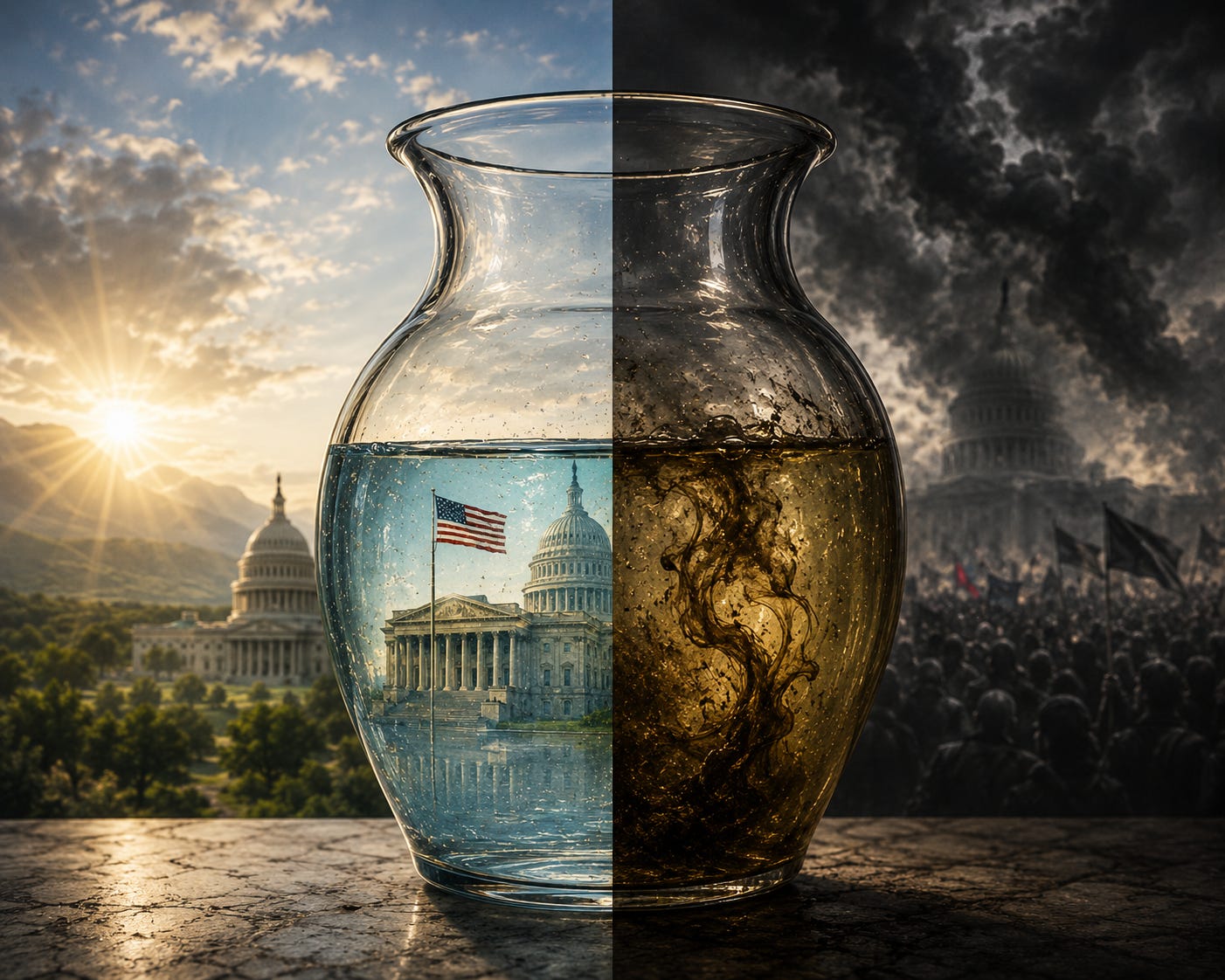
Nature abhors a vacuum.
That has always been true. Eventually, something—dust, water, smoke, or air—will fill an empty vessel. The vessel itself has no control over what fills it.
The same principle applies intellectually and ideologically.
Both major political parties are susceptible to this. After years of empty rhetoric and performative politics, both have gradually begun mistaking symbolism for substance. The difference is that Democrats are much further along in their journey toward becoming an empty vessel.
Since the heady free-love days of the 1960s, the party that opposed the Civil Rights Act has increasingly flirted with a philosophy of “if you can’t beat them, join them.” What began as accommodation with the activist left has evolved into outright dependence upon it. With the rise of the self-described “democratic socialists,” those chickens are finally coming home to roost.
For all the media insistence that everything to the right of center is “far right,” while everything left of center is simply normal, compassionate, and enlightened, there remains a very real dividing line between the extremes. The farther one moves to the right, the less government one desires. The farther one moves to the left, the greater the demand for government control.
History allows everyone to decide for themselves which serves civilization better, but my own observation is that neither extreme works particularly well. Human beings require some agreed-upon form of civil governance. Experience has repeatedly shown that the minarchist approach—a government exercising only its most essential functions—best preserves individual liberty while maintaining civil order.
That philosophy is expressed almost perfectly in the Constitution of the United States.
The problem is not with the Constitution. The problem is that it assumes people possess a basic level of intellectual honesty. It assumes they understand that every expansion of government necessarily reduces individual liberty somewhere else. It assumes they recognize that discrimination cannot be cured by more discrimination, that equality before the law is not the same thing as engineered equality of outcomes, and that language itself cannot simply be redefined whenever it becomes politically inconvenient.
Nowhere has that been more evident than in several recent Supreme Court rulings.
In Mullin v. Doe, the Court’s majority essentially held that the word “temporary” does not mean “perpetual” or “forever” and that Congress had explicitly denied courts the authority to review certain Temporary Protected Status determinations.
Likewise, in Mullin v. Al Otro Lado, the Court ruled 6-3 that an individual does not “arrive” in the United States by attempting—and failing—to enter it.
Neither case presents particularly difficult legal questions. What is remarkable is that the cases required the nation’s highest court to reaffirm the ordinary meaning of words like “temporary” and “arrive.”
Justice Clarence Thomas carried that principle further in his concurring opinion in Doe, writing that “aliens have no equal protection rights against the federal government.” His point was not rhetorical but definitional. “Illegal” still means illegal. “Alien” still means alien. Words have meanings whether politicians approve of them or not.
These disputes are ultimately manifestations of the American left’s Humpty Dumpty philosophy: “When I use a word, it means just what I choose it to mean—neither more nor less.”
Expect more linguistic and legal sleight of hand as the Democratic Party continues its radicalization. Collectivist movements have long depended upon manipulating language because reality has an inconvenient habit of resisting ideology. If words retain fixed meanings, many political arguments simply collapse under their own contradictions.
Increasingly, the activist wing is driving both the rhetoric and the policy agenda of the Democratic Party. Central to that worldview is the notion of a kind of imaginary global constitution under which every person on earth possesses the same legal claims upon the United States as an American citizen.
That is not how our Republic functions.
We create law through a defined constitutional process. Citizens elect representatives at the local, state, and federal levels. Those representatives introduce legislation within the authority granted to them by constitutions and precedent. Bills are debated, amended, passed or rejected through established procedures. Measures approved by the legislature proceed to the executive for signature or veto under powers likewise defined by the Constitution. Even vetoes may be overridden through constitutionally prescribed procedures.
Every step is governed by a process that derives its legitimacy from the consent of the governed.
Anyone of a certain age—or anyone with access to YouTube—can remember learning this from Schoolhouse Rock. Frankly, those cartoons probably provide a better civic education than many college courses today.
For all the endless lectures about respecting “the people” and preserving “democracy,” one of the least democratic habits in modern American politics is the persistent effort to disregard established law whenever it becomes inconvenient and to invent legal rights or governmental powers that simply do not exist.
Nature does abhor a vacuum.
The same is true of politics. If a political movement empties itself of constitutional principles, objective definitions, and intellectual discipline, something else will inevitably rush in to fill the space.
The trick is to fill the vessel with what it was intended to hold before someone fills it with urine and insists it is wine.
The current state of our politics is clear and simple. Gridlock, by design. Both parties, when out of power, complain about the abuses of the party in power, however when they gain power they abuse just as their competition (in name only) does. It's in elected officials' best interests to have plausible deniability, and what better way than to complain when you're the minority and then reign when you're the majority. We need congress to be reminded forcefully about Enumerated Powers, their limitations, and the penalties in loss of freedom for overreach. Forcing limitations based on enumerated powers will reduce the size and cost of government, increase oversight, and push power back to the states that never should have been moved to the federal government.
Say what you will, the Constitution always was and still is a miracle, the government it defines is the best to ever exist, and the state of our nation is the direct result of human greed, cunning, and stupidity warping government to serve elected official's needs, not those of the people.
Time to make a change.
Thing is my fellow Republicans have built up government just as much as Democrats have, specially at state, county and city levels. At 50 I never thought I'd see laws that tell you what is legal and how to do it legally. Yet we see that in 2026 and we have those laws in al 50 states.
We also see settled law being fought again. Take AI, all the lawsuits we are seeing against AI companies have already been settled decades, generations ago. The scraping content of the internet for example, well, both Yahoo and Google were sued over the something and they won.
Training computers off copyrighted materials, this goes back to the 80s.
Now both democrats and republicans pushing ID requirements for Social media usage and electronic device usage. We all know about CA, but there's 3 other states that have already passed such laws.
Obummer pushed and got passed the mandated OnStar systems in cars along with kill switch's in them and 75% of Republicans agreed with those things.
Here in Montana back in 2021 they passed the enhanced CCW pushed by Republicans. the lie they told was Washington State would recognize it, what they didn't tell people is that 75% of the firearms we own in MT are illegal in WA or the fact that WA has funky carry laws so even if you have a CCW you most likely will still get arrested in WA for carrying.
Sorry for the long rant and I know it sounds like I'm defending democrats, I assure you I'm not. I'm just pointing out the big splinter that we have in our eye that 90% of the party doesn't want to remove, let alone acknowledge it's there.