
Dead Caesar Chavez gets the E. Jean Carroll Treatment
George Orwell wrote a book about it.

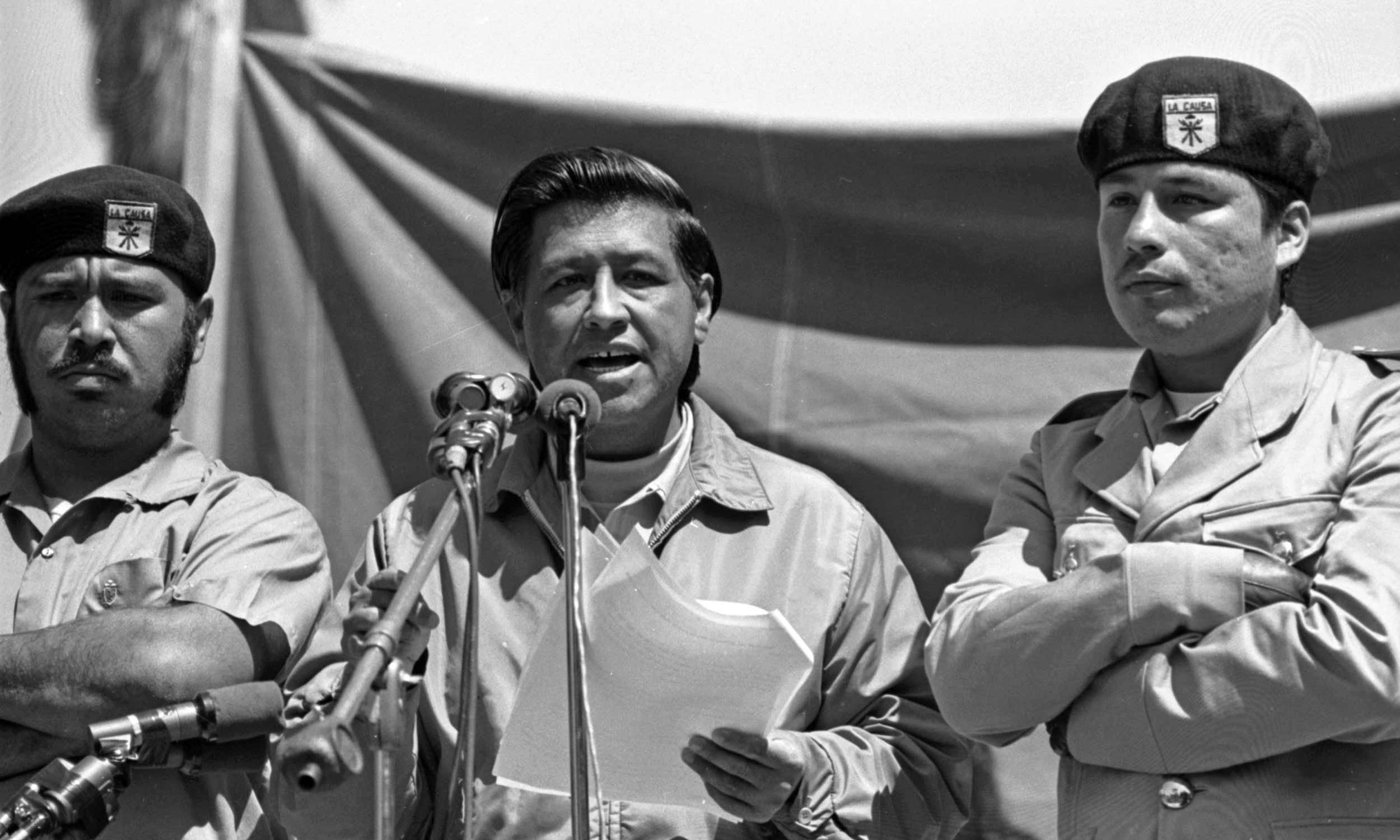
There is a familiar pattern in modern public life: when reality becomes inconvenient to Democrats, history is not debated, it is rewritten. Not corrected or refined but reshaped into something more politically useful for the present moment. We are watching that process unfold once again, and this time the subject is Cesar Chavez. For decades, Chavez has been held up as a near-sacred figure on the American left—a patron saint of labor organizing, celebrated for his Alinsky-style tactics and his role in unionizing farm workers.
There has always been an inconvenient truth beneath that mythology: Chavez was firmly opposed to illegal immigration because he understood that it depressed wages for the very workers he claimed to represent. That fact alone makes him a problem in today’s ideological environment.
So, it is time for Chavez to get the E. Jean Carroll treatment.
When an icon no longer aligns with current priorities, the response is rarely to confront the contradiction. Instead, the narrative begins to shift. In Chavez’s case, that shift appears through a combination of selective memory and late-emerging accusations that conveniently reshape his legacy decades after his death. Whether those claims are true or not almost becomes secondary to their usefulness. The timing invites skepticism. When a historical figure’s real views begin to complicate a preferred narrative, something often emerges to tarnish, soften, or displace the original story. Chavez, once useful as a symbol, now requires revision because his actual positions clash with modern orthodoxy on immigration.
The reality is that Chavez did not merely oppose illegal immigration in theory—he acted on it. His concerns were rooted in economics, not abstraction. He believed that an unchecked flow of illegal labor would undermine wage gains for American workers, particularly minority workers already competing at the margins. To address this, he supported organized efforts to deter illegal crossings, often with chains and clubs, driven by a conviction that protecting workers required limiting labor supply. That version of Chavez—a labor leader prioritizing economic leverage over ideological purity—is deeply incompatible with the modern progressive framing of immigration as primarily a moral question.
Inconvenient history must be changed.
It also tells you how important the continuance of illegal immigration is to Democrats.
This phenomenon is not unique to Chavez. It reflects a broader pattern in which public figures are split into two versions: the fictionalized icon and the inconvenient reality. The fictional Chavez becomes a generic “champion of immigrants,” stripped of his actual positions. The real Chavez, who saw illegal immigration as a direct threat to American labor, fades from view. The same transformation occurs elsewhere. Che Guevara is romanticized as a freedom fighter, while the historical record shows a man involved in executions. Ira Einhorn is loosely remembered as an environmental figure tied to Earth Day, rather than as a murderer who composted his girlfriend and fled justice. Mumia Abu-Jamal is portrayed by some as a political prisoner, while others point to his conviction for killing a police officer. Assata Shakur, aka Joanne Chesimard, was celebrated in certain circles as a revolutionary, while her role in violent crimes, including the killing of a state trooper, is often minimized.
In each case, inconvenient facts are subordinated to a more useful narrative. Complexity is flattened, contradictions are ignored, and the past is reshaped to serve present needs. This is not accidental. History has become a tool for defining what is acceptable to believe. If Chavez can be reimagined as aligned with modern immigration ideology, then opposition to that ideology can be framed not as a legitimate disagreement, but as a moral failing. The past becomes a mechanism for enforcing the present.
What makes this process particularly effective is the cultural context in which it occurs. In an educational system that often emphasizes narrative over depth, many younger Americans may have only a vague understanding of figures like Chavez, if they recognize the name at all. That absence of knowledge creates an opening. If the original story is not widely known, it becomes far easier to replace it with a revised version that better aligns with current priorities.
The result is a culture in which historical figures are remembered less for who they were than for how useful they can be made to appear. The past becomes a flexible resource—something to be curated, edited, and, when necessary, discarded. And once that shift occurs, it does not remain confined to history.
When history becomes negotiable, so does truth itself.
George Orwell wrote a book about it.
I remember the public Cesar Chavez. I also remember that he was born in the U.S., a WW II veteran, and that he opposed illegal immigration. My question is: why did Dolores Huerta wait this long to make these statements about him? What were her motives? Sympathy? Jealousy that he had a holiday named for him and she did not? Did she get some kind of payout and it ended? Too many questions that won't be answered.
They did it to Harvey Milk, too - he was a proud Jew and a Zionist (that part kind of went without saying in those much smarter times). So, both his Jewish identity and Zionism had to be erased.
I’m not even gay, or even really a leftist, but it burns me up that “Zionists”, in scare quotes because their Zionist is a construction, are no longer welcome at “Dyke March”, or other Gay Pride events.
I am from San Francisco and my burning question is: Can we change “Cesar Chavez Way” back to “ARMY Street” now? A lot of us didn’t like the renaming of such an historic major street to begin with.