
Danegeld Politics
Minnesota’s fraud scandal exposes a broader national habit: leaders who appease lawbreakers with taxpayer money and safety instead of confronting them, guaranteeing only more chaos.

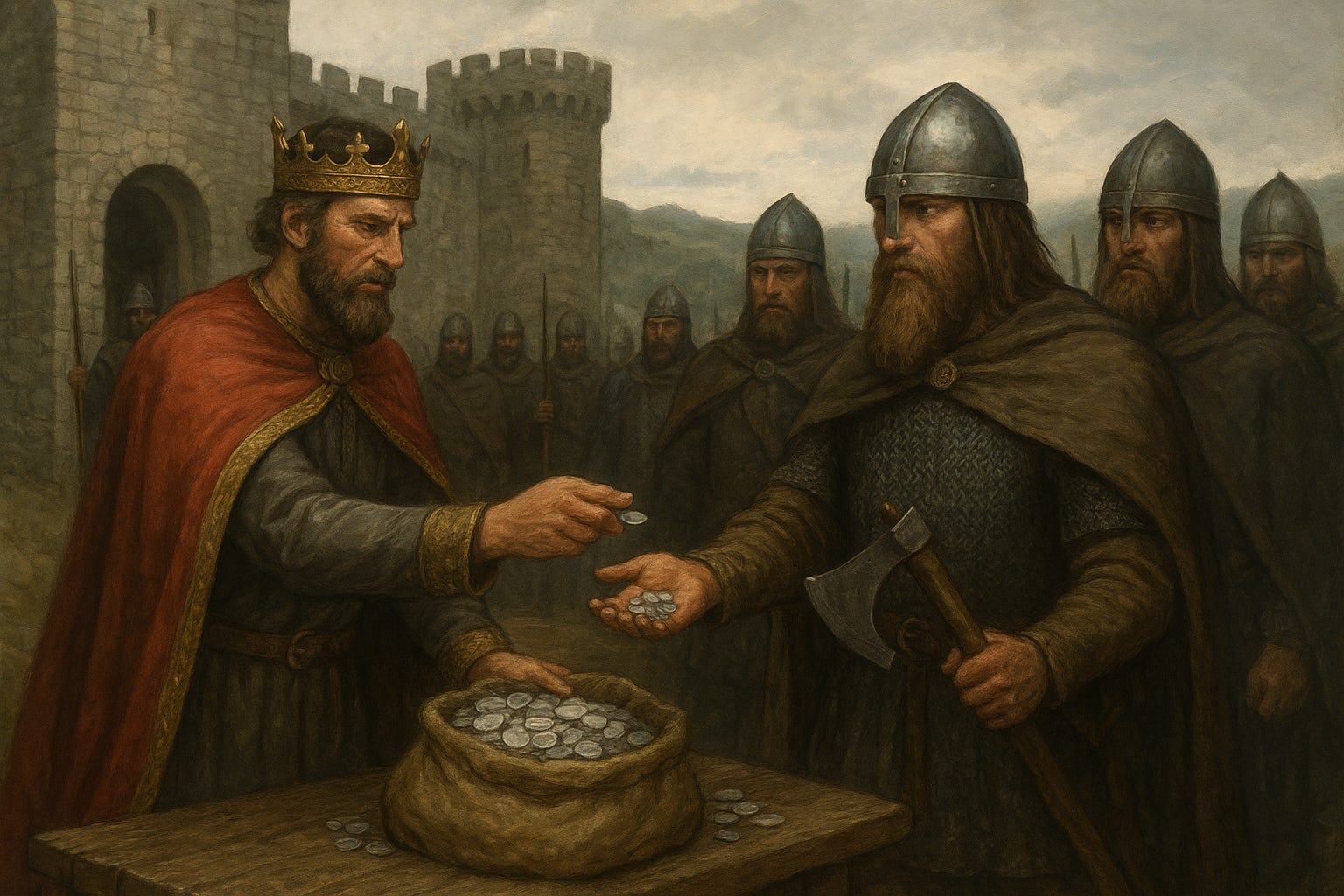
Another thought the Minnesota fraud situation dredged up...
We should remember that human history teaches a brutal but consistent lesson: once you start paying off people who threaten you, the payments never end. From ancient kingdoms to modern governments, every attempt to placate extortionists has only emboldened them. As long as the threat remains, the extortion continues—usually escalating—until the people being squeezed finally surrender their liberty, their resources, or their civic order to whoever is holding the torch or the pitchfork.
That is the dynamic many Democrats seem unwilling to acknowledge. What we saw in Minnesota, and in cities across the country during the BLM and Antifa riots—and in this fraud scheme roiling Minneapolis— wasn’t an inability to respond.
It was a choice.
That choice is also evident in the opposition to using the National Guard in a capacity short of militaristic, but in operational support and protection of federal activities. Opposing the reductions in crime the mere presence of the Guard has wrought is a form of payment to the criminals.
And that is also a choice.
The officials in charge had the legal authority and the physical means to stop the destruction—whether by deploying sufficient police presence or, if necessary, calling in the National Guard. Instead, many chose to appease the very groups burning their neighborhoods and threatening their citizens. Rather than enforce the law, they attempted to buy calm with concessions, payouts, and political indulgence.
And like every society in history that tried the same approach, it backfired.
Appeasement sends a signal: “You can get what you want by applying pressure.” Once that message lands, the cycle becomes predictable. Each new outburst results in new demands. Each demand comes with a price tag. And each price paid shifts the balance of power just a little more away from elected authority and a little more toward those willing to destabilize the streets.
This isn’t speculation—it’s a pattern as old as civilization. The British historian Rudyard Kipling captured it perfectly with the concept of “Danegeld,” the tribute medieval rulers paid to Viking raiders in the hope of being left alone. But the lesson from that era is the same today: paying the Danegeld guarantees only one thing—that more Danegeld will be demanded. Once you prove you’re willing to submit, the cycle becomes endless.
And using taxpayer money to pay the Danegeld is a form of moral hazard, where people act differently than they would if they had to face personal consequences—thereby adding another layer of assurance the scam continues until it can’t ( I knew I could sneak Herb Stein’s Law in here!).
In a truly virtuous nation, this would never happen—and America cannot afford to repeat this mistake indefinitely. A society that refuses to defend itself eventually becomes a society no longer capable of governing itself. Order, safety, and liberty don’t sustain themselves automatically. They require leaders willing to protect them—and citizens willing to insist on it.
Appeasement isn’t compassion. It’s capitulation dressed up as virtue.
And it always ends the same way.
Badly.
“If once you have paid him the Dane-geld
You never get rid of the Dane.”
Do you like Kipling?
I don’t know, I’ve never Kippled.
I've often expressed the reintroduction of the water cannon for dealing with mobs such as you have mentioned. Neville Chamberlain was unavailable for consultation.