
Conscientiousness
It's not just having a conscience that is important, it is paying attention to what it tells you.

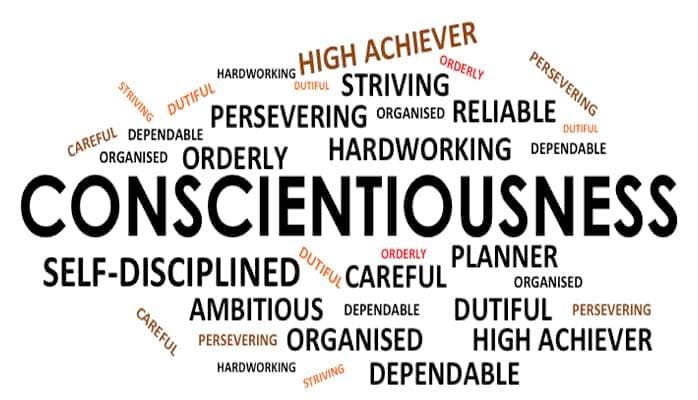
Jeff Stibel, in a 2017 article in USA Today that would never get published today, wrote:
“This may sound crazy, but there is a single trait that psychologists have studied over the years that can actually predict the answers to all of the questions I asked about. No, it is not grades in school or friendliness or confidence or emotional stability or even personality in general. It is not intelligence or persistence. Rather, it is restraint — the ability to resist temptation confidently and repeatedly. Psychologists call this conscientiousness.
Leonard Sax outlines a myriad of studies in his 2016 book on parenting that demonstrate how conscientiousness leads to positive effects. Conscientiousness is a broad personality trait that includes carefulness and organization, but Sax argues convincingly that restraint — more than anything — underlies the effect.
In 2012, psychologist Angela Duckworth showed a correlation between conscientiousness and overall life satisfaction. Psychologists Margaret Kern and Howard Friedman in 2008 demonstrated the health benefits of conscientiousness, including longer lifespan. Doctors Tom Bogg and Brent Roberts in 2013 were able to predict obesity rates in 50-year-olds by looking back at their conscientiousness scores at age 10, whereas psychologist Sarah Hampson was able to predict overall health across four decades. We can predict Alzheimer’s, substance abuse and other risk-taking behavior. Most importantly, conscientious restraint is a clear indicator of happiness and well-being.”
Stibel not some random dude with an opinion, he is a venture capital investor at BryantStibel but in 2017 he was vice chairman of Dun & Bradstreet and an entrepreneur who also happens to be a legitimate brain scientist, publishing numerous academic articles in cognitive science, psychology, economics, and business, and is a regular contributor to Harvard Business Review.
Restraint is not just an open door to happiness; it is also a predictor of the survival of our Republic and its systems.
Numerous of our Founders wrote about how our open and free society with limited government depended on self-governance, not pronouncements from some distant source of authority.
I cannot help but quote Jeff Goldblum’s character, Ian Malcolm, when he chided, “Your scientists were so preoccupied with whether or not they could, they didn’t stop to think if they should.”
Stopping to consider whether one should, is conscientiousness.
That is a missing element in Washington, DC these days.
And I will acknowledge it is missing on both sides of the aisle, in both action and reaction.
With out fear or realization of the long-term consequence, Democrats attack:
The Supreme Court (but just the “conservative” justices)
Our system of justice (perverting it to fill their political needs)
Christianity and Judaism
Western Culture
The two parent, nuclear family
Biological science
Taxpayers
The Bill of Rights
White people
Our traditional international allies
And that is just to name a few.
Each one of these attacks ratchets rhetoric to a point it cannot be walked back and destroys a little of what makes America the nation it has been.
What is true for all items above is especially true for SCOTUS. If they succeed in destroying the legitimacy of the Supreme Court in their quest for a progressive majority, the entire judicial system falls – there is no coming back from that. Their perversion of the law in their quest to stop Trump and to punish his supporters has already had significant impact on the court systems.
This is what John Adams meant in his “whale through a net” quote.
It will tear this country apart in such a way it will never be repaired. Humpty Dumpty has a better chance of being put back together again.
I have said it a thousand times – people incapable of governing themselves have no business trying to govern others.
Certainly one of your best columns.
Sad but true. 😕