
Botticelli’s Warning
A five-hundred-year-old painting explains exactly what is happening to America

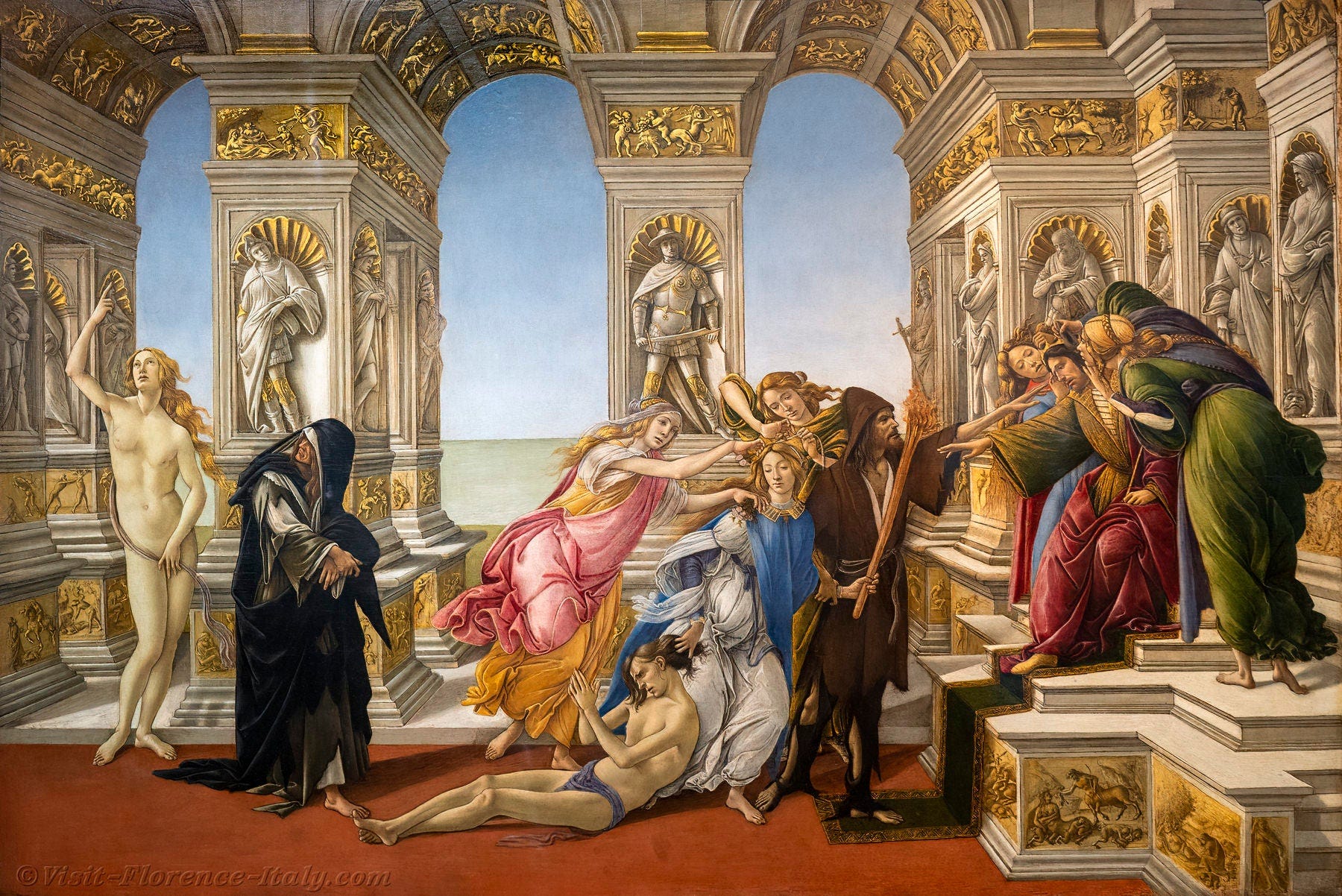
Imagine a man being dragged across the floor by his hair while accusations swirl around him. A king sits on a throne watching the scene unfold, but he cannot see clearly. Envy blocks his view while Ignorance and Suspicion lean into his ears, filling them with whispers. Behind the accuser, Fraud carefully arranges her hair so that the lie appears beautiful and persuasive. Off in the distance stands Truth—alone, naked, and almost completely ignored.
This scene was painted more than five hundred years ago by Sandro Botticelli in his final masterpiece, The Calumny of Apelles. Once the allegory is understood, it becomes nearly impossible to observe modern public life without recognizing the same machinery at work.
Several years ago, my wife and I toured the Uffizi Gallery in Florence, one of the great repositories of Western civilization. We saw Botticelli’s The Calumny of Apelles, painted around 1495 near the end of the Renaissance master’s life. I was profoundly impacted by it but at the time didn’t understand why. I do now.
“Where-ever Law ends, tyranny begins.” — John Locke
One of the most important historical characteristics of the American system has been its stability and consistency. Unlike societies governed by the passions of rulers or the shifting emotions of the mob, Americans have traditionally taken comfort in the idea that the law means the same thing today that it meant yesterday.
The rule of law is not merely a collection of statutes or court decisions. It is a cultural commitment to fairness, restraint, and predictability. It means the government does not invent punishments after the fact, and it means accusations must be proven before reputations are destroyed. Citizens live under stable rules rather than the arbitrary impulses of those who temporarily hold power.
From its founding, the American system has rejected ex post facto justice—inventing punishments after the fact to satisfy the passions of the moment. Our system rests upon the presumption of innocence and the belief that a person’s standing before the law does not fluctuate with the political winds. The founders understood that a free people cannot live under a legal system that changes meaning with every election cycle or shift in public opinion. The law must operate according to stable principles rather than political convenience, or it ceases to be law at all.
Yet something corrosive has crept into our public life. Increasingly, our political and cultural institutions appear to operate according to a different principle—one in which accusation itself becomes proof and the destruction of reputation becomes a political tactic. We are living through what might reasonably be called an Age of Calumny.
Calumny is defined as the making of false or defamatory statements about someone in order to damage their reputation. For the past several years, it has become one of the most common political weapons in American life. It has been directed most visibly at Donald Trump, but by no means limited to him. The tactic has been deployed broadly against journalists, academics, public figures, and ordinary citizens whose views fall outside the boundaries of progressive orthodoxy. Even former allies have discovered that minor ideological deviation can quickly trigger denunciation and reputational destruction.
Once the machinery of accusation begins, truth becomes almost irrelevant. Allegation becomes evidence. Suspicion becomes conviction. The accusation itself becomes the punishment. In this sense, Botticelli’s painting becomes more than Renaissance art; it becomes a precise diagnosis of a recurring political pathology.
What Botticelli captured was not a single historical moment but a recurring pattern in human affairs. Falsehood rarely arrives openly. Instead, lies are refined and polished before they reach the halls of power. They are carried forward by resentment, strengthened by suspicion, and amplified by those who benefit from confusion. By the time an accusation reaches authority, it has already been dressed up to appear credible and urgent.
In Botticelli’s allegory, authority does not deliberately choose injustice. Judgment is distorted by surrounding forces. Suspicion whispers constantly. Envy directs attention toward the accused. Fraud makes the lie appear respectable. Truth is present, but distant and easily drowned out. Injustice rarely emerges from a single villain—it arises from a network of reinforcing vices. By the time the machinery is in motion, the innocent may already be condemned before truth can even enter the room.
The architecture of contemporary media has become perfectly suited to calumny. Accusations spread instantly across social media, cable television, and online publications. Reputations collapse overnight. Corrections, if they come at all, arrive long after the damage has been done. A lie can circle the globe in minutes while truth is still tying its shoes.
The Founders understood that human beings were susceptible to precisely these passions. That is why they designed a constitutional system intended to restrain them. James Madison wrote in Federalist No. 51, “If men were angels, no government would be necessary.” Men are not angels. We are susceptible to envy, ambition, resentment, and self-interest. But Madison and the other Founders believed that a properly constructed constitutional order—combined with a citizenry committed to virtue—could prevent those darker impulses from dominating public life.
The Constitution did something extraordinary. It did not merely create a government. It placed ultimate sovereignty in the hands of the people themselves. In a sense, every citizen became a kind of king—and with that sovereignty comes responsibility.
The American people must serve as the final barrier against the forces Botticelli depicted centuries ago. It falls to us to resist Perfidy, Calumny, Rancor, Fraud, Ignorance, and Suspicion. It falls to us to seek Truth—even when truth is inconvenient or politically unfashionable.
Our history proves we can confront these forces. Time and again we have faced difficult realities, corrected injustices, and restored the principles that define our republic. The question before us today is not whether we can do so again.
The question is whether we are still willing.
We must, because when accusation replaces evidence and slander replaces law, Locke’s warning begins to echo across the centuries: where law ends, tyranny begins.
Botticelli painted the playbook of modern smear politics five hundred years before Twitter ever existed. Calumny, envy, suspicion, and fraud working together to destroy a man’s reputation while truth stands ignored—that is practically a diagram of today’s media ecosystem. Allegation becomes evidence, headlines become verdicts, and the mob convicts long before facts appear. The founders understood this danger, which is why they built a system grounded in due process and the presumption of innocence. When those guardrails collapse, calumny replaces law. And as John Locke warned centuries ago: when law ends, tyranny begins. Truth survives only when citizens refuse to be manipulated.
Read Franz Kafka's "The Trial" if you want a real analysis of today's legal, political, and societal system.