
Black Robed Rulers
As Congress shirks its constitutional role, power flows to the judiciary.

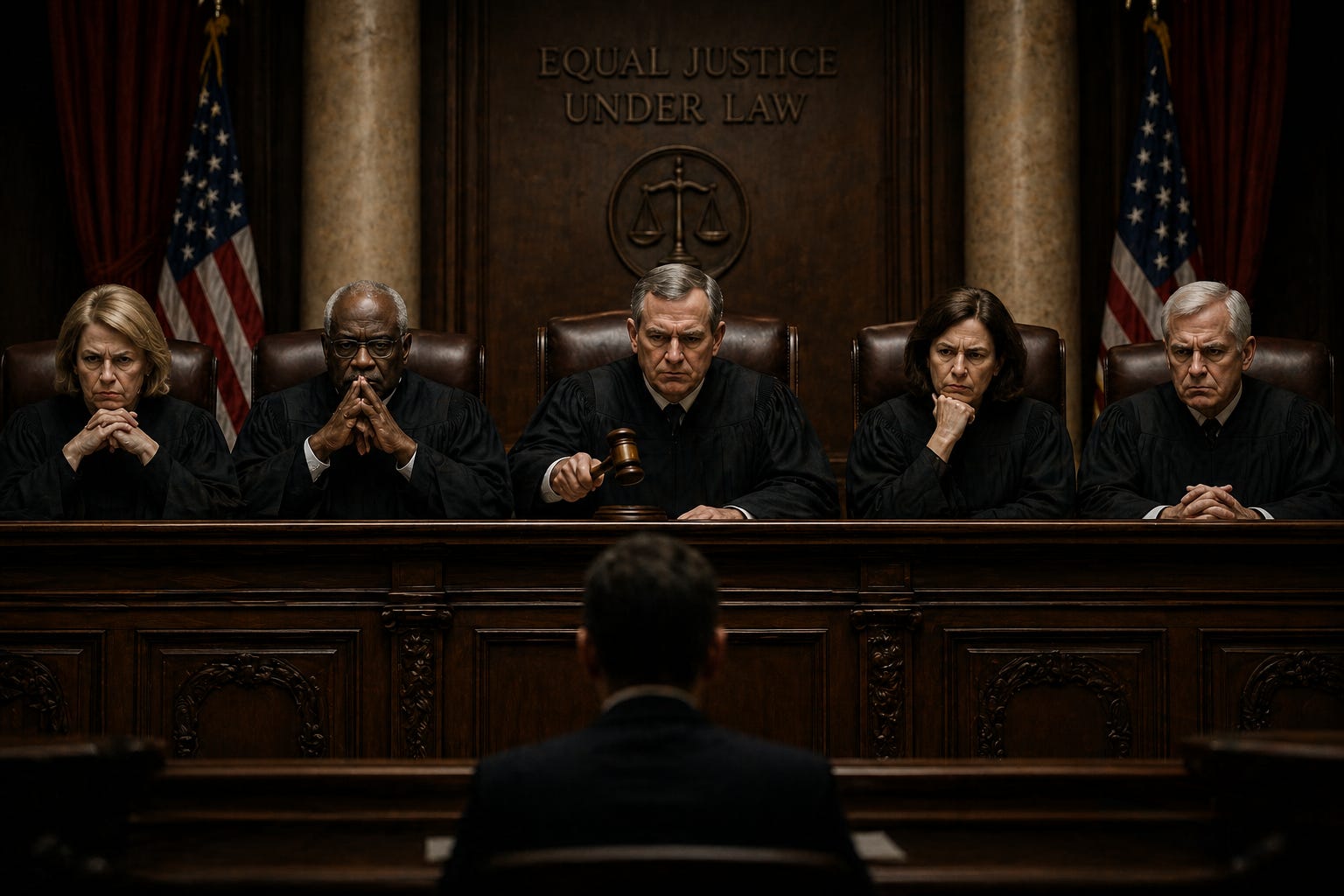
Margot Cleveland (@ProfMJCleveland – if you are not following her, you are missing out) posted a tweet on April 18, 2026, expressing concern over how much people obsess over prospective SCOTUS vacancies/appointments (i.e., who might get appointed next), and using that to argue it shows how far the judiciary has strayed into legislating from the bench—essentially becoming a ruling force rather than one that simply applies laws made by others.
The full tweet is worthy of reproduction:
“The fact that you who are reading this care as much as you do about prospective SCOTUS vacancies is an indictment of how far afield our Constitutional system has strayed. There was a time when the Republic did not wait with bated breath every summer to learn whether a justice would retire, or ghoulishly check the actuarial tables against the justices’ ages. That was when the Court restricted itself to the proper (if somewhat dull) task of applying the law made by others. But somewhere along the way justices (Thomas and Alito are notable exceptions) discovered that it is far more exciting to make up your own laws. You can even remake society in your own image! So the next time you check SCOTUS retirement rumors, take a moment to remember WHY you are checking — whereas finding out the identity of the next justice as contemplated by the Founders might be interesting, finding out your next tyrant-in-robes is life-changing.”
Twenty years ago, Mark Levin warned about this prospect in his book, “Men in Black: How the Supreme Court Is Destroying America” by becoming what would essentially be a “super legislature” (a lot of this is because Congress – GOP and Dem alike – has become a feckless and worthless body, losing interest in governing and becoming what is basically a grand distributor of our tax money).
Professor Cleveland’s tweet is really interesting in light of the Grand Spanberger Deception in redistricting that just transpired this week and the ballot initiative to ostensibly “hear the voice of the people” on how a 6-5 Dem/GOP representation in the US House is “unfair” and should be changed to a “fair” 10 Dem/1GOP representation.
What I found interesting was not only the deception required but also the number of laws and regulations that had to be ignored just to get the deceptive language on the ballot.
The exact ballot language is what got this whole thing into trouble, because it wasn’t a neutral, “here’s what this does” description. It was written in a way that framed the outcome as reform while obscuring the mechanism.
Here’s the operative wording as it appeared on the ballot (condensed only for formatting, not substance):
“Shall the Constitution of Virginia be amended to require that congressional districts be established in a manner that is fair, competitive, and reflective of the Commonwealth’s population, and to provide for the creation of districts that prohibit partisan gerrymandering?”
I suppose people might not get the not so subtle messaging here that the former districts were drawn unfairly, they weren’t competitive or reflective of the Commonwealth’s population when the 6-5 representation accurately reflected a state population that Kamala Harris received only a 5 point edge over Trump in the presidential election.
Somebody who did notice was Circuit Court Judge Jack Hurley Jr. He laid out a consistent set of reasons for invalidating the redistricting amendment and blocking certification:
Failure to follow constitutional and statutory procedures
The court found the amendment process did not comply with required legislative rules for constitutional changes.
This included issues with how and when the General Assembly approved the amendment, including use of a special session outside its proper scope.
Timing and notice violations
Virginia law requires advance public notice (often cited as ~90 days) before a constitutional amendment goes to voters.
The judge concluded those notice requirements were not properly met.
Improper authorization of the ballot measure
The ruling held the amendment was not correctly authorized before being placed on the ballot, meaning the referendum itself was procedurally invalid.
Misleading or defective ballot language
The judge also criticized the referendum wording as misleading to voters, which independently undermines its legality.
Violations of multiple state laws governing referenda
In the post-election ruling, the court said the entire process “broke several state laws,” making all votes legally ineffective.
Constitutional concerns about the amendment itself
The measure was deemed unconstitutional in structure and process, not just flawed procedurally
It isn’t like this was unknown before the election. In January 2026, the circuit court ruled the amendment process was legally defective, focusing on procedural and constitutional violations. However, ballots were already being prepared or cast, the ruling didn’t immediately stop the election machinery, and the Spanberger regime went ahead anyway.
It seems clear the Democrats are looking to the Virginia Supreme Court to put their 10-1 plan in play—which brings us back to Professor Cleveland’s tweet and Mark Levin’s book.
It’s not like we weren’t warned.
Good writing, but people still have to be willing to educate themselves on ballot initiatives, rather than just giving blind faith to the news media to report things responsibly (which they don't).
As Hakeem Jefferies said "War everywhere all the time." Pray for the sheeple to wake up to this and reject it.
There was no doubt what Comrade Spanbooger was trying, and thankfully someone wearing a black robe called her on it. Will the Virginia Supreme Court support her or the law? No known, however if the Virginia SC rules for her, SCOTUS will have a bite at the apple. If nothing else her gerrymander is probably dead for the 2026 midterms.