
A Tale From a Lost Generation
I posted a little about this earlier, but thought it needed a little more fleshing out.

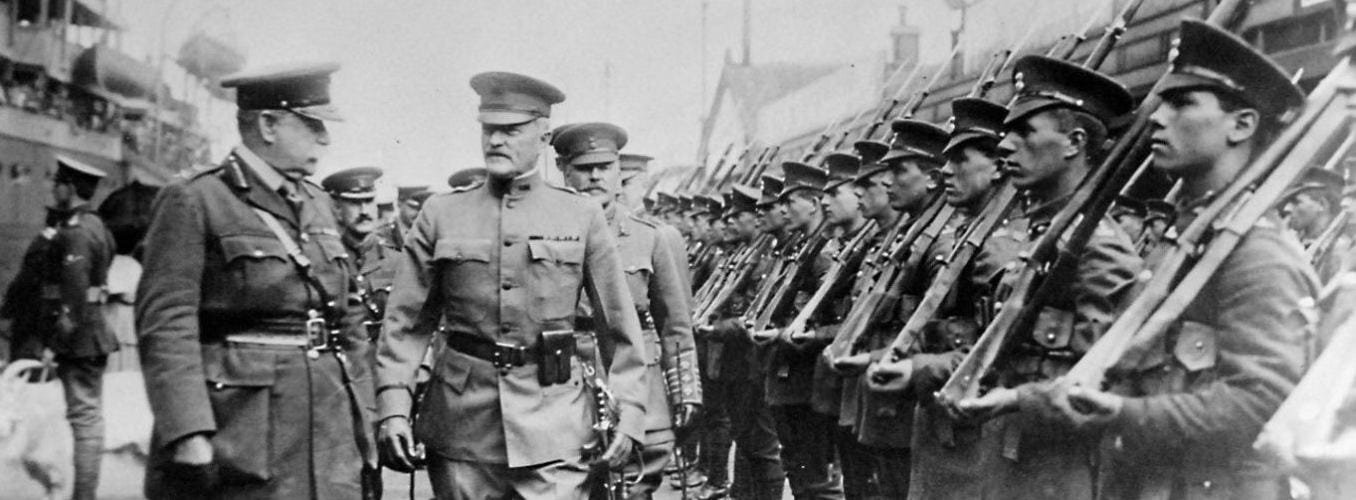
In an earlier post, I noted that when I was younger, I was the protégé of a very learned man who had seen both world wars firsthand. He was a family friend, knew my grandfather and my dad and shared their thirst for knowledge and love of family. By the time I knew him as a person rather than a family friend, he was well into his seventies and had lost his wife. He had also lost his only child, a son, in the Korean War.
His own experiences transformed him from a young (he was 17) ideological adventurer, when he joined the American Expeditionary forces in Europe, into an ardent anti-communist when he exited the US Army after WWII.
He's been gone nearly three decades, but I do remember our conversations vividly. I worked part time for him during my summers in high school and we probably spent as much time talking about things as I did actual work. I think he was the first person outside my own family who treated me as an adult and as a result, didn’t shy away from difficult or controversial subjects. He used to tell me that “I have no one to whom to bequeath my knowledge, one day your generation will own the world, and I have a duty to prepare you for it.” Years passed before I understood he wasn’t joking.
We spoke often about current events, and since he lived through some of the most historic parts of the American story, we had many conversations about how people interacted with their government and how he saw the different forms of government and the changes he had personally witnessed, foreign and domestic.
He spent time in the UK and Europe after the war and watched as the Marshall Plan kicked in and how each of the devastated economies and governments began to reassemble themselves under the funding provided though the support from America.
He watched the changes in the UK as it mutated into soft socialism, sort of a paternal socialism as an adjunct to the English monarchy – which was still greatly respected and protected at the time, as well as the hard communism of Russia, as well as the Soviet’s aggressive desire for expansion – he noted that they had every much a desire to capture all of Europe as Hitler did.
When I asked what he thought the differences were that drove communism versus America’s open-armed embrace of capitalism, he noted a couple of things. The first was something he called the “free will” model – this was how he explained America – he said the most unique thing about America was that it created a nation with minimal and yet broad set of principles in which the resulting society and economic system grew organically around it. There was nothing that specified what we wound up with, so his conclusion was that the economic systems and society that developed were the best available to exist within a very loose framework.
He proposed the opposite for the pre-Soviet Russians. His premise was that they began with the economic system first – and the only way communism would work was under a rigidly controlled government and a society coerced and controlled to behave as outlined by the government - and the nation that resulted was the USSR.
He said the communist ideology is mutually exclusive, it involves either the heart or the intellect – saying for example that the heart desires equity but ignores consequences of achieving that equity, while the intellect fully understands the consequences but doesn't care because all it sees is achievement of a goal. The former is the way communism is always sold to the people; the latter is the actual result.
He contrasted this with capitalism and classical liberalism (now called conservatism), which require both heart and mind, akin to the Christian faith required to accept Christ as savior (he was a devoted Christian). He warned that without the emotional commitment of the heart, the mind alone can (and often is) very cruel. I would argue that being cruel is a necessity to implement a communist state because some are not going to be on board with giving up their individualism.
I think about our discussions whenever I hear someone talk about how “heartless” conservatives and capitalism are and then I always marvel at how the main feature of communism has always been its heartlessness.
Watching the films about the Sobibor revolt it is hard to fathom the gratuitous sadism of the SS. But the Antifa of Portland reflected the same bullying and self-entitlement.